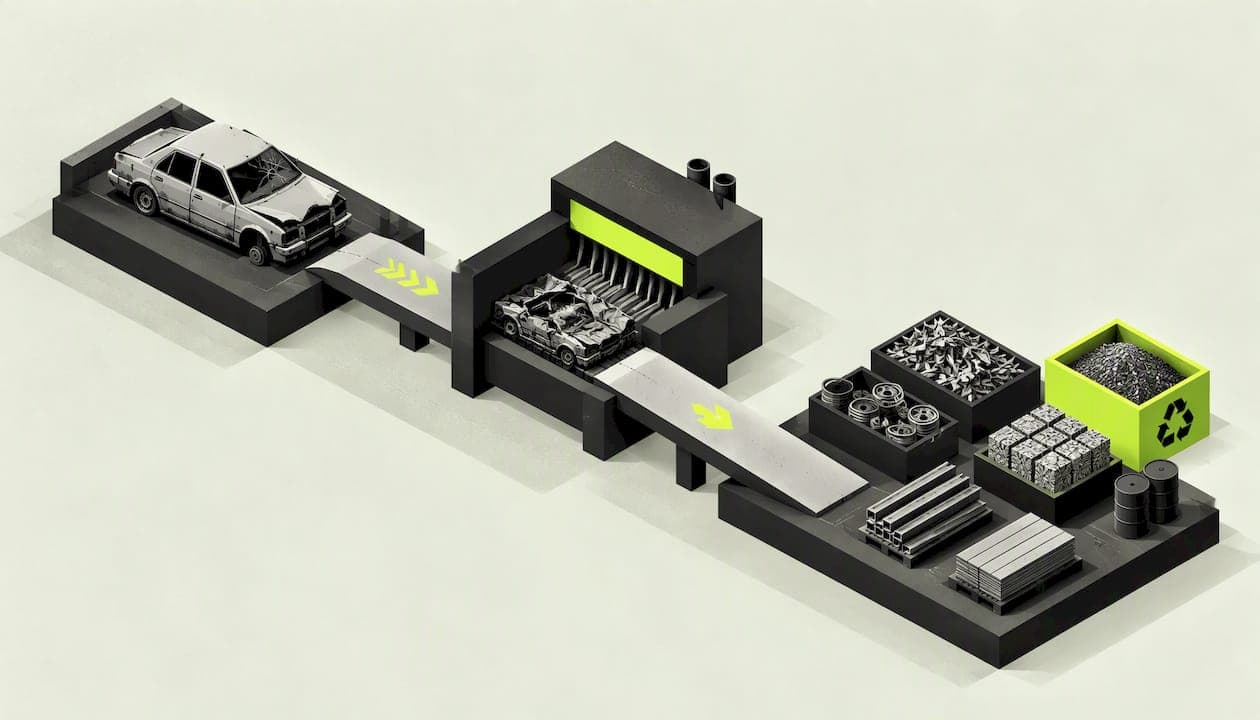
A junk car does not end up in a field. After pickup it goes to a yard, where hazardous fluids are drained, usable parts are pulled, and the leftover shell is crushed and shredded so the metal can become new steel, aluminum and copper. Most of the car is reused. The U.S. automotive recycling industry reports that about 86% of a vehicle's material content is recycled, reused or recovered for energy.
Below is the full path, step by step, what it means for the money you are paid, and what Ohio sellers should do so the car is truly off their hands.
TL;DR
- A junk car is picked up, inspected, drained of fluids, stripped of reusable parts, then crushed and shredded for metal.
- Hazardous items such as fuel, oil, coolant, refrigerant, mercury switches and lead-acid batteries come out first, under strict handling rules.
- Your payment depends mostly on weight and current scrap metal prices. Condition mainly affects the value of reusable parts.
- In Ohio, make sure the title or paperwork is transferred correctly so you are not liable for the car afterward.
- Selling directly to a local yard that tows and pays at pickup is usually faster and pays more reliably than donating or listing it.
Table of Contents
- The short version: from your driveway to new steel
- Step 1: Pickup and transport
- Step 2: Inspection and paperwork
- Step 3: Draining fluids and removing hazardous parts
- Step 4: Pulling the reusable parts
- Step 5: Crushing and shredding
- Step 6: Metal goes back to mills
- The numbers behind car recycling
- Why recycling a car matters for the environment
- What this means for your payment
- Selling, donating or trading in: which path fits
- Protecting yourself as the seller in Ohio
- Our perspective: why the local yard matters
- Ready to sell your junk car in Cincinnati?
- FAQ
- Sources
The short version: from your driveway to new steel
The journey has six stages. Each one exists for a reason, and each one affects what the buyer can pay you.
- Pickup and transport
- Inspection and paperwork
- Draining fluids and removing hazardous parts
- Pulling reusable parts
- Crushing and shredding
- Sorting metal and sending it to mills
The process looks much the same from yard to yard. The details differ with the size of the facility and the price of scrap that week.
Step 1: Pickup and transport
Most junk cars cannot be driven, so the buyer sends a flatbed or tow truck. With us, towing is free and there is no hidden towing fee. The truck arrives, the driver confirms the vehicle matches what you described, and you are paid in cash on the spot before the car leaves.
This is where selling to a local yard differs from working through a broker network. The yard that gives you the offer is the one that sends the truck and hands you the cash. There is no middle layer reselling your lead to someone else.
If you want the details on how pickup works for large vehicles, our guide to junking a truck in Cincinnati in four steps walks through it.
Step 2: Inspection and paperwork
When the car reaches the yard, it is inspected and logged. The yard checks what is still on it: the battery, the catalytic converter, the wheels, the engine, the interior. It also checks the paperwork, because a yard needs a clean ownership record before it can legally process the vehicle.
In Ohio, this matters more than most sellers realize. A buyer who processes cars correctly will make sure the vehicle is correctly titled, including titles marked for destruction where that applies, so the previous owner does not stay on the hook. Ohio law also sets out a process for authorized entities to obtain a salvage certificate of title for an inoperable vehicle worth $1,500 or less so it can be disposed of through a salvage dealer or scrap processor.
Missing a title is not always a dead end. We buy vehicles without a title as long as you can provide current registration and your ID. See junk cars for cash without a title in Cincinnati for how that works, or our guide to what paperwork to have ready in Ohio and Kentucky.
Step 3: Draining fluids and removing hazardous parts
This is the stage that separates a licensed recycler from a car dumped behind a barn. According to EPA guidance for vehicle processors, all hazardous fluids are drained and collected: engine oil, transmission fluid, brake fluid, antifreeze and refrigerant. They are stored in labeled containers with secondary containment so a leak does not reach the ground.
The same guidance says the battery should come out first, because that makes everything else safer to handle. Then the following items are removed before the car is flattened:
- Lead-acid batteries, which hold roughly 18 to 20 pounds of lead each
- Mercury switches, found in places such as hoods, trunks and anti-lock brake sensors
- Lead wheel weights
- Fuel, which is drained and stored for proper handling
Why does this matter to you as a seller? Because the environmental stakes are real. New Hampshire's environmental agency notes that a single gallon of gasoline can contaminate 750,000 gallons of water, and it urges owners to use only a licensed auto recycler. Handing a car to someone who drains it properly keeps those fluids out of local soil and groundwater.
Step 4: Pulling the reusable parts
Before a car is crushed, the yard takes what can be sold again. Depending on the vehicle, that can include:
- Engines and transmissions that still work or can be rebuilt
- Alternators, starters and electronics
- Doors, bumpers, mirrors and body panels in good shape
- Wheels, tires and aluminum rims
- The catalytic converter, which contains precious metals
- Seats and interior pieces
This is why condition matters, though less than people expect. Industry experts describe the parts value as the part of the price that responds to condition, while the base metal value stays put. A wrecked, non-running car still carries a baseline value because it still weighs what it weighs. A newer car with an intact engine and clean body panels can earn more because more of it can be resold as parts.
For a deeper look at the math, read why a whole car can earn more by scrap weight, or use our walkthrough to calculate your junk car's value yourself.
Step 5: Crushing and shredding
Once the car is stripped and depolluted, the remaining shell is flattened to make it cheaper to move. Then it goes to a shredder, which tears it into fist-sized pieces. Magnets pull out the iron and steel. What is left is sorted further, often by machine, to recover non-ferrous metals such as aluminum and copper.

The leftover mix of plastic, foam, glass and fabric is called shredder residue. It is the hardest part of a car to recycle, and it is the main reason the recycled share is 86% and not 100%.
Step 6: Metal goes back to mills
The sorted metal is sold to mills and foundries, where it is melted and turned into new products. Steel from old cars can become new vehicle parts, appliances, rebar and other construction material. Aluminum and copper go through their own recycling streams.
The same logic applies to many other scrap streams, from vehicles to household metal. Services focused on scrap metal removal and recovery show how reusable components and metals get separated and sent back into use.
The numbers behind car recycling
It helps to see the scale. According to the Automotive Recyclers Association's industry statistics, the professional industry:
| Measure | Figure |
|---|---|
| Vehicles recycled each year (U.S. and Canada) | Over 4 million |
| Annual sales (U.S.) | About $32 billion |
| Facilities | More than 9,000 |
| Jobs | More than 140,000 |
| Material content recycled, reused or recovered | About 86% |
New Hampshire's environmental agency adds that motor vehicles are the number one recycled product in the U.S., ahead of items people think of first, like bottles and paper.
Why recycling a car matters for the environment
The benefits come down to four things:
- Less pollution at the source. Fluids and heavy metals are collected instead of leaking into soil and water.
- Less mining. Every ton of steel, aluminum and copper recovered from a car is a ton that does not have to be pulled from the ground and refined from ore.
- Less landfill space. A car is large, and most of it can be reused.
- Local jobs and reuse. Parts that go back on the road keep other cars running at lower cost.
The EPA's own educational material on the topic notes that before dedicated auto wreckers existed, many people left old cars to rust in fields and yards, and that almost every part of those wrecks could be recycled. That is the problem a licensed yard solves.
What this means for your payment
The single biggest driver of what you are paid is weight, combined with the current market price for ferrous metals like iron and steel and non-ferrous metals like aluminum and copper. Scrap prices move, so an offer from last spring may not match one today.
On top of that base, the buyer adds value for parts that can be resold. That is why two cars of similar weight can get different offers: one has a sellable engine and a clean interior, the other was in a fire.
A few practical points:
- Condition moves the offer less than you might think. A car that does not run, is wrecked, has high mileage, or is flood damaged still has metal value.
- Be honest about damage. If a car was flooded, say so. Our guide on selling a flooded car in Cincinnati explains why disclosure keeps the deal clean.
- Compare offers on the same terms. Ask whether towing is free, whether the offer is the amount you will actually receive, and when you are paid. We offer free quotes with no obligation, free towing, and cash at pickup with no last-minute deductions.
- Check current numbers. Our article on scrap car prices in 2026 covers what Cincinnati sellers are seeing.
Selling, donating or trading in: which path fits
The route you pick changes what happens to the car and what you receive.
| Option | What happens | What you get |
|---|---|---|
| Sell to a local junk car buyer | Towed away, processed by a yard | Cash at pickup |
| Donate to a charity | Usually sold, often at auction | A possible tax deduction |
| Trade in at a dealer | Dealer decides whether to resell or wholesale | Credit toward another car |
| Sell privately | You find a buyer and handle the paperwork | Possibly more, if the car still runs |
| Leave it or abandon it | Can become a legal and environmental problem | Possible fines and towing costs |
On donations, the IRS rule is narrower than many people assume. For a qualified vehicle with a claimed value above $500, the deduction is generally limited to the gross proceeds of the charity's sale. If you need money and not a receipt, a direct sale is usually the clearer win. If you itemize and are considering a donation, talk to a tax preparer or CPA about your own situation first.
For trade-ins and private sales, see trade in or sell privately to see when each makes sense for a car that barely runs.
Protecting yourself as the seller in Ohio
What happens to the car after pickup is the yard's job. What happens to your liability is partly yours. Three habits keep you covered:
- Transfer the title properly. Sign it over to the buyer and keep a copy or photo. If a title is missing, ask the buyer how they handle it before you commit.
- Write a bill of sale. It records the date, price, vehicle details and both parties. We cover it in junk car bill of sale in Ohio.
- Remove plates and personal items. Check the glove box, trunk and under the seats. Then contact the Ohio BMV about your plates and registration, and your insurer about canceling coverage.
If the title is missing and you cannot find registration either, there are four paths to junk a car without registration.
You should also know what Ohio law says about cars left on property. Ohio's statute defines an abandoned junk motor vehicle and requires a record and photograph for those vehicles. A car left to sit can become someone else's legal problem, and then yours. If a car has been parked for months, a call to a local buyer is easier than waiting for a notice. For questions about your specific situation, the Ohio BMV or a licensed attorney is the right person to ask.
Our perspective: why the local yard matters
We have a simple view of this business. A car you no longer want still has real value, in its metal and its parts, and the owner should be paid for it fairly and quickly. Most of the frustration people have with junk cars comes from three things: waiting for a check, being surprised by a fee, and not knowing where the car went.
So we work to remove all three. We tell you the offer up front, tow the car for free, and pay cash at pickup. We do not make last-minute deductions, and there is no pressure to accept the quote. You deal with the local yard that makes the offer, sends the truck and pays you, not a call center that passes your details along.
We also think the term "junk car" sells these vehicles short. A wrecked sedan or a truck that has not started in three years is a pile of recoverable material. Putting it in the hands of a yard that drains the fluids, removes the hazardous parts and sends the metal back into use is better for the people who live around it, and better for the owner who has been looking at it in the driveway.
— Yoshua
Ready to sell your junk car in Cincinnati?
If your car is sitting and you want it gone, we buy cars, trucks and SUVs across Cincinnati and the Tri-State area in any condition: not running, wrecked, salvaged, high mileage or flood damaged. Get a free, no-obligation offer, and if you accept, we tow the vehicle for free and pay you cash at pickup. You can also read how our cash for junk cars service works, or see details on free junk car removal. Owners of larger vehicles can go straight to selling a truck or SUV for cash.
FAQ
What happens to cars when they go to the junkyard?
They are inspected, drained of fluids, and stripped of batteries and hazardous parts. Then the useful parts are pulled for resale, and the remaining shell is crushed and shredded. The metal is sorted and sold to mills for reuse.
What happens to junk cars after they are crushed?
Crushed cars are sent to a shredder, which breaks them into small pieces. Magnets separate steel and iron, and other systems recover aluminum and copper. The recovered metal is melted and made into new products.
Do I get paid more if my junk car still has good parts?
Often, yes. The base price comes from weight and scrap metal prices, and reusable parts add to it. A car with a working engine or clean body panels can bring a higher offer than a burned or stripped one of the same weight.
Can I junk a car in Ohio without a title?
Sometimes. We buy vehicles without a title when you can provide current registration and ID. Rules differ between buyers, so confirm how yours handles the paperwork before you agree to a sale.
Is donating a junk car better than selling it?
It depends on your goal. If you want cash, selling is simpler, since the IRS generally limits the deduction for vehicles over $500 to what the charity gets when it sells the car. If you plan to claim a deduction, ask a tax professional first.
Sources
- Automotive Recyclers Association: industry statistics
- U.S. EPA: Processing End-of-Life Vehicles poster
- New Hampshire DES: Do You Know Where Your Junk Car Goes?
- Ohio Revised Code Section 4505.103
- Ohio Revised Code Section 4513.63
- U.S. EPA Recycle City: Auto Wrecker
- IRS Publication 526 (2019)