
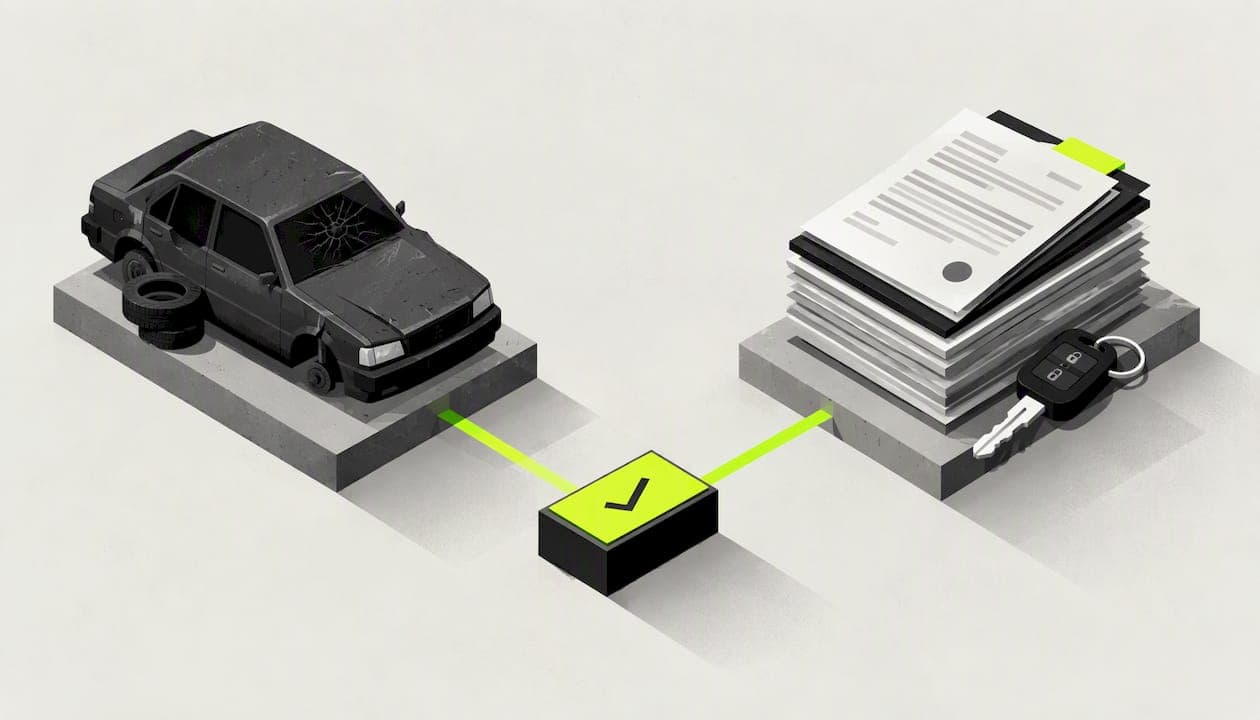
To junk a car around Cincinnati you need proof that the car is yours, a signed title (or the right substitute), a photo ID, and a plan for the license plates. If a bank still holds a lien, you also need the lien release. Ohio and Kentucky each have their own rules, and the Tri-State area crosses both, so the details below depend on which side of the river your title was issued.
We buy junk cars for cash in Cincinnati and the Tri-State area, so we handle this paperwork every week. This guide covers what to gather, how to sign it, what to do when something is missing, and the mistakes that cause trouble months after the car is gone.
TL;DR
- Bring the title, a government photo ID, and the lien release if you ever had a car loan. Sign only when the buyer is in front of you.
- Ohio and Kentucky both expect the seller's signature on the title to be notarized, so confirm with your buyer before signing anything.
- No title? You usually have options: a duplicate title, an electronic-title transfer, or a buyer who accepts current registration plus ID. We cover the last one on our no-title page.
- Never hand over a title with the buyer's line left blank, and keep copies of everything you sign.
- Cancel insurance and deal with plates only after the car has left your driveway.
Table of Contents
- The short checklist
- The title: the document that matters most
- Ohio: what the state asks of you
- Kentucky: the Northern Kentucky side
- Photo ID and proof it is really your car
- The bill of sale
- Plates, registration and insurance
- What if you have no title?
- What we do differently on paperwork
- Your pickup-day sequence
- Ready to sell? Here is how it works with us
- Common mistakes that cause problems later
- FAQ
- Sources
The short checklist
Here is the paperwork in the order most sellers need it.
| Item | Needed? | Notes |
|---|---|---|
| Certificate of title | Usually | Must be in your name. Ohio may hold it electronically. |
| Government photo ID | Yes | Name must match the title or registration. |
| Lien release | If a loan existed | Lender's letter or a title showing the lien cleared. |
| Bill of sale | Strongly recommended | Date, VIN, price, both names, both signatures. |
| Registration | Helpful, essential without a title | Current registration plus ID is what we accept when the title is missing. |
| License plates | Handle at pickup | Rules differ by state; see below. |
| Keys | Nice to have | A car with no keys can still be towed. |
The rest of this article explains each line.
The title: the document that matters most
A title is the legal record that you own the car. A junk car buyer is taking ownership of it, so the title is what lets the transfer happen cleanly. Check three things before pickup day:
- The name. The owner printed on the title is the person who has to sign. If two owners are listed, both usually need to sign, so ask the buyer how the "and" or "or" between names is treated.
- The brand. Check for a salvage, rebuilt or other brand. It does not stop you from selling the car, but tell the buyer upfront.
- The lien section. If a lender is listed and the loan is paid off, you need proof of that (more below).
Signing it correctly
Sign in the seller's assignment area, in the buyer's presence, in pen, with no cross-outs or correction fluid. Mistakes can void the document. Kentucky's transportation agency specifically warns against white-out and scratching through information, and says errors call for official affidavits that are signed and notarized.
One rule applies everywhere: never sign and leave the buyer's name blank. An "open title" can be filled in by whoever ends up holding it, and any tickets, tolls or legal problems tied to the car could trace back to you. Write the buyer's name and business on the title yourself, at the time of sale.
Ohio: what the state asks of you
If your title was issued in Ohio, the Ohio BMV explains that the seller completes the assignment of ownership on the back of the paper title and has their signature notarized, then gives the title to the buyer. Plan for that before the truck arrives. A notary can be found at many banks, credit unions and shipping stores, and some will notarize for free if you are a customer.
The same BMV page says title transfers should happen within 30 days of the sale or a late fee applies. That deadline falls on the buyer's side, but it is another reason to sign promptly and keep a dated record of the sale.
If your Ohio title is electronic
Ohio titles are often held electronically, especially when a lender was involved. In that case there may be no paper in your drawer at all. According to the BMV, the seller of an electronically titled vehicle completes page 1 of form BMV 3770 and has the signature notarized, then hands both pages to the buyer to finish the transfer at a Clerk of Courts title office.
You can also convert an electronic title to paper. Ohio's title guidance lists an $18 fee for the conversion at a county Clerk of Courts office, and notes some local offices add a surcharge. Check your county's current fee before you go.
Ohio loans and lien releases
If you financed the car, the lender held the title until the loan was paid. Once it is paid off, you should receive either a paper title free of the lien or a release. Without it, nobody can transfer a car with an open lien. If the lender is gone or the letter is lost, contact the lender or your county Clerk of Courts title office before you schedule a pickup.
Kentucky: the Northern Kentucky side
Many of our customers live in Boone, Kenton and Campbell counties. Kentucky has its own rules: titles must be properly signed over, and the signatures must be notarized to be valid, according to the state's vehicle titling guidance. The same page says the title must be transferred to the new owner within a set window after the sale, so do not let a signed title sit around.
Two Kentucky details are worth knowing:
- Speed titles. Kentucky offers a speed title processed by the next business day for $25.00, but it cannot be used for titles branded as junk or unrebuildable.
- Junking a title. Kentucky has an Application to Junk a Vehicle Title (TC 96-351). The form warns that junking a title puts a permanent salvage brand on it and that the car would have to be rebuilt to return to the road. In plain terms: do not file it casually. If you are selling the car to a buyer who will salvage or resell it, the right move is normally to transfer the title to that buyer, not to junk the title yourself.
If you are unsure which state's rules apply, go by the state printed on the title and where the sale takes place, and ask your buyer. A local yard that works both sides of the river should know both.
Photo ID and proof it is really your car
The buyer needs to match you to the title. Bring a driver's license or state ID with the same name that appears on the paperwork. If you have changed your name since the title was issued, bring the marriage certificate or court order. If the owner has died, the person selling usually needs the death certificate and proof of authority to act for the estate, and the exact documents depend on the state and the situation. Call the buyer first, and if the estate is complicated, talk to the probate court or a licensed attorney.
If the car is in someone else's name, such as a relative's, you cannot just sign for them. The named owner has to sign, or you need legal authority to do so. A casual note saying "it's okay" is not a substitute for the title.

The bill of sale
Some states do not require a bill of sale for a car sale. Make one anyway. It takes two minutes and gives you written proof of when the car left your hands. Include:
- Date and time of pickup
- Year, make, model and full VIN
- Odometer reading, if you know it
- Sale price and the fact that it was paid in cash
- Printed names, addresses and signatures of the seller and the buyer
- A line stating the car is sold as-is
Take a photo of the signed bill of sale and the signed title, front and back, before the truck leaves. If a toll notice or parking ticket ever lands in your mailbox, those images end the discussion quickly. We suggest keeping them for at least three years.
Plates, registration and insurance
Plate rules are state-specific, and getting them wrong can leave the car attached to your name in the state's records. In Ohio and Kentucky, plates generally belong to the owner rather than the car, so take them off at pickup and ask your county clerk or BMV office what to do next: transfer them to another vehicle or surrender them. Confirm the current rule with your local office, because it can change.
Order matters with insurance. Cancel only after the car has been picked up, the title is signed over and the plates are dealt with. Cancel earlier and you may leave a gap that causes problems, since some states penalize registered vehicles that show no insurance. If the car is on a policy with other vehicles, call your insurer and tell them the sale date.

If your tags are expired, you can still sell. Our post on selling a car with expired tags walks through the checks.
What if you have no title?
This is the most common paperwork problem we see. You have four realistic paths, and the right one depends on how fast you need the car gone.
- Request a duplicate title. In Ohio, a replacement uses form BMV 3774 at a Clerk of Courts title office, and in Kentucky you apply through your county clerk. It is the cleanest route if you can wait. Our guide on the duplicate car title process lists what to bring.
- Check whether the title is electronic. In Ohio the "missing" paper may never have existed. The Clerk of Courts can look it up, and the transfer can run through the electronic process above.
- Clear the lien. If the title is stuck at a lender, the lien release is what you need, not a new title.
- Sell to a buyer that accepts registration and ID. We buy vehicles without a title as long as you provide current registration and your ID. Details are on our no-title page, and our post on junking a car without registration covers the harder case where the registration is missing too.
Be wary of anyone who says no paperwork is needed at all. A buyer that takes a car without any proof of ownership is taking a risk that tends to come back to the seller, and it may be a sign the buyer is not operating legally.
What we do differently on paperwork
Here is our point of view, after handling these transfers day in and day out.
Most paperwork trouble comes from two things: surprises on pickup day and sellers who do not know what they are signing. Our approach is to keep the deal simple and local. You deal directly with the yard that gives the offer, sends the truck and pays the cash, rather than a national broker that passes your car along to someone else. That means one phone call settles the questions about your title, your lien and your state's rules before anyone drives out.
We tell you what documents we need when we give the quote. We tow for free, we do not take last-minute deductions at the curb, and we pay cash at pickup. If something is missing, we say so in the first conversation, not after the tow truck has arrived. And if the best answer for your situation is to get a duplicate title first, we will tell you that too, even if it means the sale takes a few days longer.
Our one firm piece of advice: do not rush the signature. A paused sale costs you nothing. A wrongly signed title can cost weeks.
— Yoshua
Your pickup-day sequence
If your paperwork is in order, the pickup itself takes a few minutes.
- Get a quote and confirm the documents the buyer needs. You can start on our instant offer page.
- Locate the title, registration, ID and any lien release. Put them in one folder.
- If your state requires notarized signatures, arrange the notary before the buyer arrives, or ask the buyer how they handle it.
- Remove personal items, toll tags and the plates.
- Check the offer against what was quoted. Count the cash before you sign.
- Sign the title in the proper box, write in the buyer's name, and complete the bill of sale.
- Photograph all signed documents and keep copies.
- Then cancel insurance and notify your state office as needed.
Ready to sell? Here is how it works with us
If the car is wrecked, flooded, high-mileage or just no longer running, we buy cars, trucks and SUVs in any condition across the Cincinnati and Tri-State area. Towing is free, there are no hidden towing fees, the quote carries no obligation, and we pay cash at pickup. See our cash for junk cars page for the process, or read about our free junk car removal service.
Common mistakes that cause problems later
- Signing in the wrong place or using correction fluid. Ask for a replacement title rather than altering the original.
- Leaving the buyer line blank. This creates an open title and leaves you exposed.
- Skipping the notary when your state calls for it. The buyer may not be able to transfer the car, and the delay lands on you.
- Forgetting the lien. A paid-off loan without a release is a common reason a sale stalls.
- Cancelling insurance too soon. Wait until the car has actually gone.
- Not keeping copies. Photos cost nothing and protect you for years.
- Selling to someone who will not put the price in writing. Get the offer clearly stated before the tow truck arrives.
FAQ
What do you need to junk a car in Ohio?
You need the title in your name with your signature notarized in the assignment area, a photo ID, and a lien release if you had a loan. If the title is electronic, the seller completes the BMV 3770 with a notarized signature instead. Take the plates off at pickup and keep copies of what you sign.
Can I junk a car without a title in Cincinnati?
Sometimes. You can apply for a duplicate title, or sell to a buyer that accepts other proof. We buy vehicles without a title when you provide current registration and your ID. Call us first so we can confirm what your situation needs.
What do you need to junk a car in Kentucky?
The title signed over to the buyer with notarized signatures, plus ID and any lien release. Kentucky says errors must be fixed with signed, notarized affidavits, not white-out. Do not file a junk title application yourself if you are selling to a buyer who will salvage or resell the car.
Do I need a bill of sale to junk a car?
It may not be legally required in your state, but you should still write one. It records the date, VIN and price, which protects you if the car is later involved in a violation or a registration dispute.
Should I cancel my insurance before the tow truck comes?
No. Cancel after the car has been picked up, the title is signed over and the plates are handled. Cancelling early can cause gaps or penalties in some states.
Sources
- Ohio BMV: Vehicle Titles
- Ohio Public Safety: e-titling and lien release visual aid
- Kentucky DRIVE: Vehicle Titling
- Kentucky Transportation Cabinet: Application to Junk a Vehicle Title (TC 96-351)