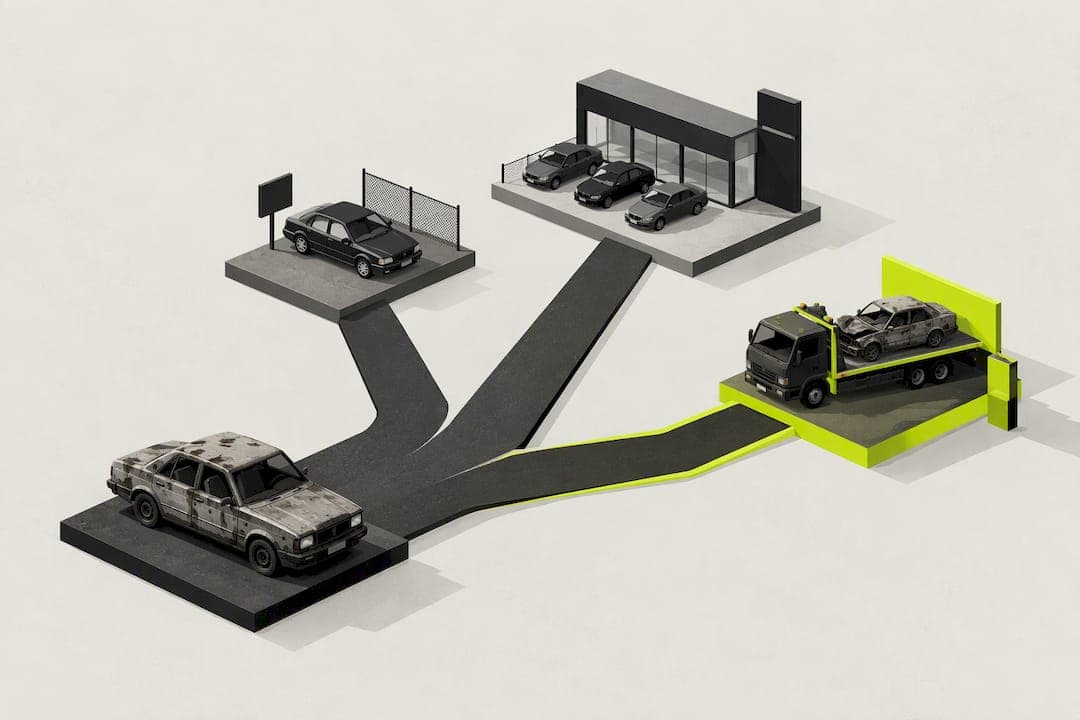
If you want the most cash and have time, sell privately. If you want speed, safety, and minimal paperwork, trade it in. For non-running or salvaged cars, a local cash-for-junk buyer is usually your best route. The right choice comes down to three things: how much money you need, how much time and risk you're willing to accept, and your car's actual condition.
TL;DR:
- Compare at least two offers, including a written dealer quote and a realistic private sale estimate, then use the gap to negotiate.
- Dealer transactions and junk car sales can close the same day, while private sales commonly take several weeks from listing through completion.
- For private sales, verify funds directly with the bank and avoid payment apps, gift cards, or cryptocurrency; fake checks can leave sellers liable.
- Cars that do not run or have heavy damage attract few private buyers, so request two junk buyer quotes and confirm towing and title requirements.
- Keep a signed bill of sale, completed title transfer, lien release, and odometer disclosure; personal vehicle losses generally are not deductible on federal taxes.
Table of Contents
- Selling privately: expected outcomes, steps, and risks
- Trading in: what dealers consider, benefits, and hidden value
- Decision checklist: how to pick between trade-in, private sale, or a junk-cash buyer
- Paperwork and tax basics in the United States for car sellers
- When to use a cash-for-junk service: non-running, salvaged, or unwanted vehicles
- What local experience teaches about picking the right sale route
- How Cincinnati Junk Cars for Cash can help
- FAQ
- Sources
Selling privately: expected outcomes, steps, and risks
Selling your car yourself typically brings in a higher sticker price than a dealer trade-in, since you're pricing to another individual rather than a dealer who needs to resell at a profit. But the number you see in your listing isn't the number that lands in your pocket. Net proceeds, what you actually keep, means subtracting the time you spend, any repairs or detailing you pay for to make the car presentable, listing fees on some platforms, and the cost of your own labor fielding calls and texts.
A private sale generally follows a predictable sequence:
- Prep the car: wash it, fix small issues, gather maintenance records.
- List it on multiple platforms with clear photos and an honest description.
- Field inquiries and screen out obvious scams or lowball offers.
- Schedule test drives in a public, well-lit location.
- Verify payment before handing over keys or signing the title.
- Complete the title transfer and notify your state's motor vehicle agency.
That last step carries real risk. The FTC warns that fake-check scams target online car sellers, where a buyer sends a counterfeit check for more than the asking price and asks you to refund the difference. When the check bounces, you're on the hook for the full amount, not just the overpayment. The FTC has also flagged a newer twist: scammers spoofing dealership websites to pose as legitimate buyers or sellers, which means verifying who you're actually dealing with matters as much as verifying the payment itself.
The safest payment methods are the boring ones. Cash in a bank lobby, a verified cashier's check confirmed directly with the issuing bank, or an in-person bank transfer all beat any payment app, gift card, or cryptocurrency request, which the FTC lists among common scam-payment red flags.
Pro Tip: Meet buyers at your own bank branch. You can verify funds on the spot and complete the transfer before anyone drives away.

Trading in: what dealers consider, benefits, and hidden value
Dealers set trade-in offers based on wholesale auction data, your car's condition, and what it will cost them to recondition it for resale. That reconditioning cost, detailing, minor repairs, inspection, gets baked into a lower number than what a private buyer would pay, since the dealer needs margin to resell the car profitably.
What you give up in price, you often gain in convenience:
- Immediate payoff of any remaining loan balance as part of the transaction.
- Fast, same-day title transfer handled entirely by dealership paperwork.
- A possible sales-tax advantage in states that tax only the price difference between your trade-in and a new purchase.
- Zero buyer screening, no strangers test-driving your car, no fraud exposure.
USAA's consumer guidance recommends comparing at least two offers before deciding, since trade-in values can vary meaningfully between dealers depending on current wholesale demand for your specific make and model.
Trade-in tends to win when speed matters more than maximizing price, when you're already buying another vehicle and want one transaction instead of two, or when local demand for your particular car is soft and a private sale would likely sit unsold for weeks. It also wins when you simply don't want to deal with strangers calling about your car at dinner time.
Decision checklist: how to pick between trade-in, private sale, or a junk-cash buyer
Run through this before you commit to a route:
- Set your target number. Check Kelley Blue Book for a private-party estimate and a trade-in estimate side by side, so you know the realistic range for your car's year, mileage, and condition.
- Estimate your time budget. A private sale commonly takes several weeks from listing to closing; a trade-in or junk-cash sale can close the same day.
- Assess the car's condition honestly. Running and presentable cars have the widest pool of private buyers; non-running or heavily damaged cars have almost none.
- Check your loan payoff. If you owe more than the car is worth, a dealer can often roll the difference into a new purchase in ways a private buyer cannot.
- Weigh your comfort with strangers. If meeting unknown buyers, scheduling test drives, and verifying payments sounds stressful, that discomfort has real value.
- Get at least two real offers. One dealer trade-in quote and one private-market estimate (or salvage quote, for damaged cars) gives you a floor to negotiate against.
A simple rule of thumb: if the dealer's offer is within a few hundred dollars of what you'd realistically net privately after time and risk, take the trade-in. If the gap is large and you have the bandwidth to manage a sale, go private.
Pro Tip: Get your dealer trade-in quote in writing before you list the car privately. It costs nothing and gives you a real number to beat, not a guess.
Paperwork and tax basics in the United States for car sellers
Both routes involve a short paperwork checklist: a bill of sale, title transfer, payoff of any lien, an odometer disclosure, and notifying your state's motor vehicle agency of the sale. Keep copies of everything, including the buyer's information and the final sale price, in case questions come up later about the loan payoff or the transaction itself.
On taxes, IRS Publication 544 explains that selling a personal-use vehicle rarely creates a taxable gain, and that a loss on the sale of a personal vehicle is generally not deductible. Most people selling a car they've owned and driven won't owe federal tax on the sale or be able to write off a loss, since personal-use property is treated differently than business or investment property.
Paperwork essentials to keep on hand:
- Signed bill of sale listing price, date, and both parties' information.
- Title signed over to the buyer, with lien release attached if applicable.
- Odometer disclosure statement, required in most states at time of sale.
- Confirmation of DMV or state title-transfer notification.
Keeping these records protects you if a dispute comes up later, whether it's about the sale price, the vehicle's condition, or who was driving it after the sale date.
When to use a cash-for-junk service: non-running, salvaged, or unwanted vehicles
A car that doesn't run has a tiny pool of private buyers, since most people shopping privately want something they can drive home. Trade-in isn't always an option either; dealers often decline non-running vehicles outright or offer so little it isn't worth the trip. That's the gap a dedicated cash-for-junk buyer fills.
A straightforward cash-for-junk transaction typically includes:
- Free towing, so you're not paying to move a car that doesn't move itself.
- Instant, on-the-spot cash payment instead of waiting on a mailed check.
- Acceptance of vehicles in many title situations, including missing titles when you bring current registration and valid ID.
We buy vehicles across the Tri-State area regardless of whether they're wrecked, flood-damaged, high-mileage, or simply sitting unused, and we recommend getting a salvage or junk-cash quote alongside any dealer trade-in offer before deciding, since the two numbers can differ substantially for a damaged car.
Pro Tip: Call at least two junk-car buyers for a quote before accepting the first number. Offers are based mainly on weight and condition, so pricing can vary between buyers.
What local experience teaches about picking the right sale route
Most of the confusion in this decision comes from treating "sell my car" as one problem instead of three separate ones. A running, clean car in decent demand is a private-sale candidate. A car you need gone fast, with a loan to pay off, is a trade-in candidate. A car that doesn't start, has frame damage, or has been sitting for a year is neither, it's a junk-cash situation, and trying to force it into the other two paths usually wastes weeks.
Whichever route you pick, verify the payment method before you hand over keys, confirm the title transfer actually happens, and get a receipt. Those three habits prevent almost every bad outcome I've seen sellers run into.
— Yoshua
How Cincinnati Junk Cars for Cash can help
If your car is wrecked, salvaged, not running, or just not worth the hassle of a private sale, we make the process simple. We offer free towing with every purchase, pay instant cash at pickup instead of mailing a check, and give no-obligation quotes so you know what to expect before committing. We also buy cars without a title as long as you bring current registration and valid ID.

Getting started takes a few steps:
- Request your instant cash offer online or by phone.
- Confirm a pickup time that works for you.
- Have your ID and registration ready at pickup.
- Accept cash and a receipt on the spot, no waiting required.
If you're dealing with a diagnostic question before deciding whether a repair is worth it, an independent shop's breakdown of diagnostic fees can help you figure out whether fixing the car makes more sense than selling it as-is. For everything else, from trucks and SUVs to sedans in any condition, our junk car services page covers the full process. Get your quote today and see what your vehicle is worth, no pressure, no fees, no waiting on a check.
FAQ
Is it better to sell privately or trade in?
It depends on your priority: private sale typically nets more cash but takes more time and carries more risk, while trade-in is faster and safer with a lower payout. USAA's guidance recommends comparing at least two offers before deciding, since the gap between routes varies by vehicle and local demand.
What is the $3,000 rule for cars?
This isn't a recognized IRS or industry rule, and no official source defines a "$3,000 rule" for vehicle sales. If you've seen it referenced, it likely refers to an informal budgeting guideline rather than a tax or legal threshold, so it's worth confirming the source before relying on it.
How much less do dealers pay for trade-ins?
Dealers base trade-in offers on wholesale auction values minus the cost of reconditioning the car for resale, which generally puts the offer below what a private buyer would pay. The exact gap depends on your car's condition, mileage, and current demand for that model.
Why is trade-in lower than private party?
A dealer has to resell your car at a profit after covering detailing, repairs, and inspection costs, so the trade-in offer reflects wholesale value rather than what an individual buyer would pay directly to you. In exchange, you get a faster, safer transaction with none of the buyer-screening or fraud risk that comes with selling privately.
What should I do with a car that doesn't run?
A non-running car has very few private buyers and dealers often won't accept it in trade, so a dedicated cash-for-junk buyer is usually the most practical option. Look for free towing and instant payment at pickup, and confirm whether the buyer accepts vehicles without a title if yours is missing one.
Sources
- Publication 544 (Sales and Other Dispositions of Assets) | Internal Revenue Service
- Fake check scam targets online car sellers | Consumer Advice (FTC)
- Should I sell or trade in my car? | USAA