The fastest way to junk a truck is to request an instant offer, schedule free pickup, and collect payment immediately when the tow truck arrives. We walk that exact process every day at Cincinnati Junk Cars for Cash, where Tri-State area owners get cash on the spot without waiting on a check. Before you start, have your title, VIN, and vehicle details ready to avoid delays.
TL;DR:
- Most offers are based on the truck's weight and the resale value of reusable parts, with intact major components increasing the payout.
- Buyers typically pay in cash at pickup, and signing over the title along with proof of ownership is essential to avoid future legal issues.
- Having your vehicle's title, registration, and key details ready speeds up the process and may boost the final offer.
- Selling the whole truck for quick, free towing and immediate cash generally yields faster results than parting out or weight-based scrapping.
- Environmental regulations require licensed handling of fluids and batteries; do not drain or remove hazardous parts before pickup.
Table of Contents
- How does the junk truck selling process work?
- What paperwork do you need before requesting an offer?
- How do buyers calculate your truck's offer?
- What should you disclose about pickup access?
- How does payment and title transfer actually happen?
- Should you sell whole, part it out, or scrap for weight?
- What happens to fluids, batteries, and hazardous parts?
- Is a quick local sale worth the trade-off?
- Ready to request your instant offer and schedule free pickup?
- FAQ
- Sources
How does the junk truck selling process work?
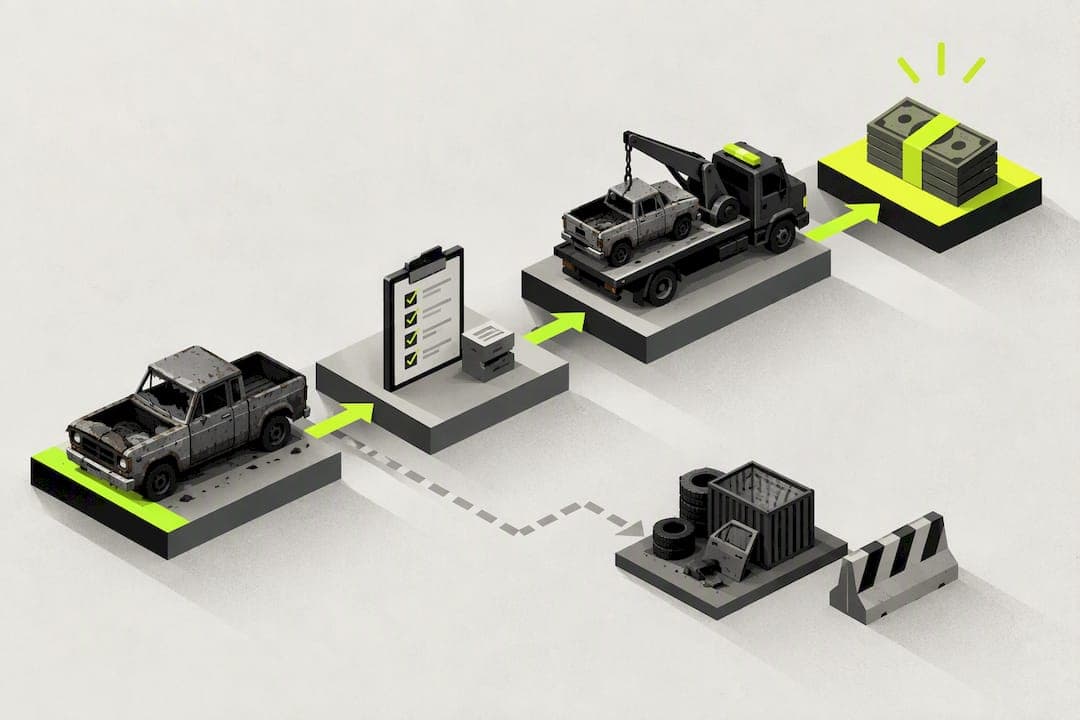
Selling a truck for scrap or salvage follows a short, predictable sequence once you pick a buyer.
- Request a quote: Submit your truck's year, make, model, VIN or license plate, mileage, and condition through an online form or by phone.
- Get your offer: Many buyers give an instant online estimate, while others confirm the number over a quick phone call after reviewing your details.
- Accept and schedule: Once you accept, pick a pickup window, often same-day or next-day depending on your location and the buyer's route.
- Hand off and get paid: The tow operator arrives, you sign over the title, hand over the keys, and receive payment before the truck leaves your property.
That last step matters most. A legitimate buyer pays in full at pickup rather than mailing a check later, and the tow itself should cost nothing. If a buyer asks you to pay for towing or wants to delay payment, treat that as a signal to find another offer.
What paperwork do you need before requesting an offer?
Buyers move faster when you walk in prepared. Most will ask for a short list of documents and vehicle facts before they finalize a number.
- Vehicle title: the preferred document, since it proves ownership and allows immediate transfer.
- Registration and photo ID: a common fallback when the title is lost, though acceptable alternatives vary by state and buyer.
- VIN, license plate, year, make, and model: needed to generate an accurate quote.
- Mileage and condition notes: including whether the truck runs, starts, or has obvious damage.
- Photos: a few clear shots of the exterior, interior, and any damage help confirm the offer before pickup.
Gathering vehicle details and ownership documents in advance speeds up quoting and often increases what you walk away with, since buyers can quote with confidence instead of discounting for uncertainty.
Pro Tip: If you're unsure whether your state allows a sale without a title, check with your local DMV before you schedule pickup so there's no last-minute holdup.
How do buyers calculate your truck's offer?
Two factors drive most offers: scrap metal weight and the value of reusable parts. A heavier truck generally pulls a higher base price purely on weight, but a complete, intact vehicle usually earns more than a stripped one because dismantlers can resell working components before recycling the rest.
- Weight-based scrap pricing: the baseline value tied to the truck's metal content.
- Parts-driven value: added when the engine, transmission, or other major components still work.
- High-value components: catalytic converters, batteries, and working transmissions often raise an offer, so removing them beforehand can lower it.
- End market differences: a dismantler buying for parts resale may offer more than a buyer selling straight to a shredder.
This is why two nearly identical trucks can get different quotes from different buyers. The one with its catalytic converter and battery intact, and no missing major parts, almost always nets more than a shell.
What should you disclose about pickup access?
Towing equipment and scheduling depend heavily on where your truck sits and how easy it is to reach.
- Report locked vehicles or missing keys so the driver brings the right tools.
- Flag missing wheels or a non-rolling truck, since that changes which tow equipment is needed.
- Mention soft ground, steep driveways, or tight spaces that could complicate a standard flatbed approach.
- Note if the truck is blocked by other vehicles or parked somewhere with limited clearance.
Accurate access details prevent surprises and help the crew bring the right equipment the first time, keeping your pickup on schedule rather than rescheduled. A few minutes clearing a path and removing personal belongings before the truck arrives keeps things moving quickly.
How does payment and title transfer actually happen?
Most legitimate buyers pay cash at pickup, with some offering an immediate check instead. Either way, you should get paid before the truck leaves, not days later.
- Sign the title: endorse it over to the buyer, typically on the back where it asks for the seller's signature and odometer reading.
- Get a bill of sale: this documents the transaction and protects you if questions come up later.
- No title on hand: alternatives exist in many states, but confirm the exact requirement with your state DMV before pickup day.
- Keep copies: hold onto the signed transfer paperwork and payment receipt in case the vehicle's registration needs to be canceled later.
Skipping the paperwork step is the most common reason sellers run into trouble weeks after the truck is gone, so treat it as part of the sale, not an afterthought.
Should you sell whole, part it out, or scrap for weight?
Your choice comes down to how much time, storage space, and tools you have versus how much extra money you're chasing.
- Sell the whole truck: the fastest route when you want speed, free towing, and a same-day payout.
- Part it out: worth considering if you have storage space, basic tools, and time to find buyers for individual components.
- Scrap for weight: the simplest option when the truck has few usable parts left or you have no time to manage separate sales.
Pro Tip: If your main goal is clearing the driveway this week, selling whole almost always beats the extra weeks of effort that parting out requires.
Parting out can net more money in theory, but it also means storing a dead truck for weeks while you track down buyers for individual pieces. For most owners, the time saved by selling whole outweighs the marginal gain.

What happens to fluids, batteries, and hazardous parts?
Professional buyers follow environmental handling steps you shouldn't attempt yourself. EPA guidance for automobile salvage yards calls for draining fluids on arrival, segregating used oil and coolant, removing batteries and mercury switches, and applying stormwater controls to limit runoff. The EPA's processing guide for end-of-life vehicles goes further, detailing model-year checklists for mercury switches and safe battery handling.
Don't drain your own fuel, oil, coolant, or battery before pickup. These are regulated waste streams that licensed facilities are equipped to handle safely.
Before you accept an offer, it's reasonable to ask where the truck will be processed and whether the buyer follows standard environmental practices. On pickup day, keep the area clear, disclose any leaks, and let the crew handle fluid and battery removal.
Is a quick local sale worth the trade-off?
For most people sitting on a dead truck, speed beats squeezing out every last dollar. An instant offer with free towing and cash on the spot removes the guesswork, the waiting, and the risk of a buyer who never shows up with payment. You might get a bit less than you'd earn parting out the engine and transmission separately, but you save weeks of storage, listing, and negotiating with strangers.
— Yoshua
Ready to request your instant offer and schedule free pickup?
If your truck is sitting unused, we make the process short: tell us the year, make, model, and condition, and we send back an offer with no obligation to accept it.

- Request your offer: use our instant cash offer page or call us directly with your truck's details.
- Have your paperwork ready: title preferred, but we also buy vehicles without one when you bring registration and ID.
- Schedule your pickup: we tow it for free and pay you in cash the moment the truck is loaded.
Trucks and SUVs in any condition, running or not, qualify for a straightforward cash offer. There's no pressure to accept, no hidden towing charges, and no waiting on a mailed check once the deal is done.
FAQ
Who will pay the most for a junk car?
The buyer willing to pay the most is usually the one who can resell your truck's parts rather than just scrapping it for weight, since a complete vehicle with working components typically earns more than a stripped shell. Getting a few quotes and comparing how each buyer values your specific truck is the only way to know for sure.
How much will a junkyard pay for a car that doesn't run?
A non-running car's offer depends mainly on its weight and whether major components like the engine, transmission, catalytic converter, and battery are still intact. A complete non-runner generally earns more than one missing key parts, since the buyer can still recover value beyond scrap metal.
Is it better to scrap or sell my junk car?
Selling whole to a buyer who pays cash and tows for free is usually faster and less work than scrapping for weight alone or parting it out yourself. Scrapping for weight only makes sense when the vehicle has little usable value left and you want the fastest possible exit.
Who gives the best price for scrapping a car?
The best price usually comes from a buyer who evaluates both scrap weight and any reusable parts, rather than quoting on weight alone. Comparing a couple of offers before you accept helps confirm you're not leaving money on the table.
Sources
- How to Sell a Junk Car Easily — Carfax
- Processing end-of-life vehicles: EPA sector M — automobile salvage yards (EPA)
- Processing end-of-life vehicles: A guide for environmental protection, safety and profit — EPA (NEPIS)