Most junk cars are typically worth a few hundred dollars for scrap metal alone, though a complete vehicle with an intact catalytic converter and usable parts can bring noticeably more. The biggest factors are weight, catalytic converter condition, and how complete the car is. Your fastest path to a real number: request a no-obligation cash offer, or run the DIY calculation below in about ten minutes.
TL;DR:
- Multiply vehicle weight in tons by the local scrap price per ton, then add value for an intact converter, working battery, and usable parts.
- Scrap prices shift with market and location, so call two or three local buyers using identical condition and weight details to compare current offers.
- A private sale may pay more for a running car, while parting out makes sense only when resale proceeds justify removal, storage, and sales work.
- A missing title does not always prevent a sale; ask whether current registration and matching ID suffice, confirm towing is free, and verify payment comes at pickup.
Table of Contents
- How a junk car calculator works
- What's a junk car actually worth? Real ranges
- How to calculate your junk car's value yourself
- Where to sell and how to get the highest offer
- From quote to cash: what to expect
- What buyers actually look for when they make an offer
- The real question isn't the price, it's the effort
- Get a cash offer for your junk car today
- FAQ
- Sources
How a junk car calculator works
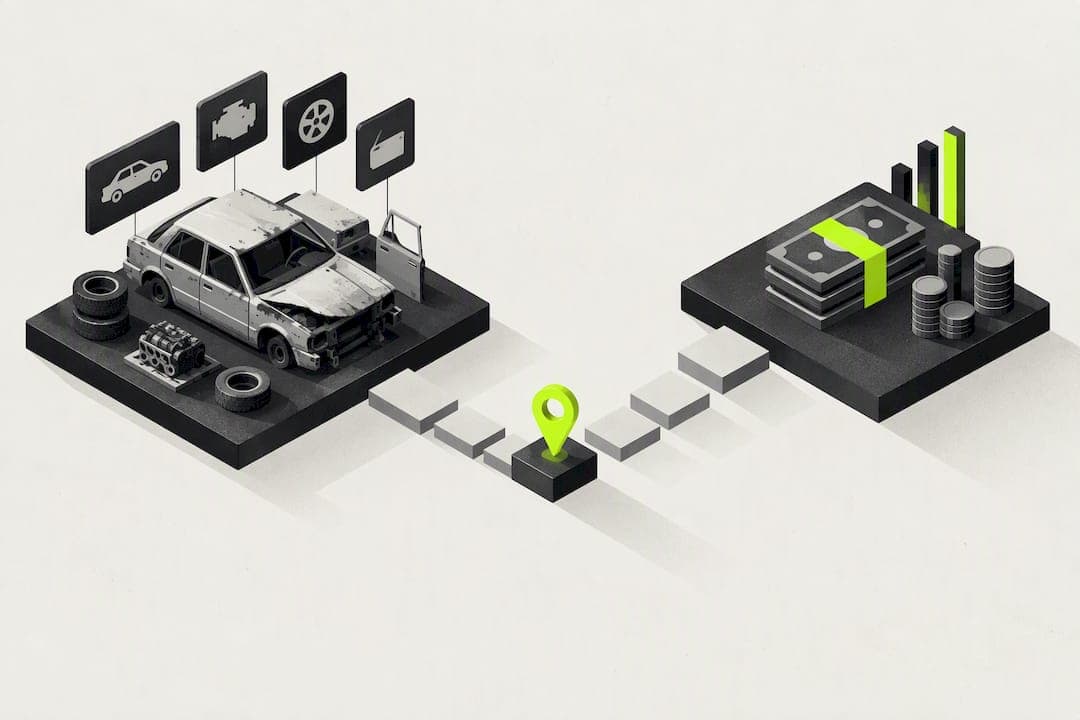
Online and phone-based junk car calculators run on a handful of inputs: vehicle weight (sometimes called tonnage), the current local scrap metal price per ton, which salvageable parts remain, and any make or model adjustments buyers apply for in-demand components. Catalytic converters get their own premium because the metals inside them, platinum, palladium, and rhodium, carry separate resale value from the car's steel body.
A buyer typically starts with a base metal value: weight multiplied by the local price per ton. From there, they add or subtract based on what else is on the vehicle.
- Weight and tonnage: heavier vehicles (trucks, SUVs) generally produce a higher base scrap value than compact cars.
- Catalytic converter: an intact, unstolen converter can add a meaningful premium over the metal-only price.
- Salvageable parts: working alternators, transmissions, and body panels raise the offer; missing or damaged parts lower it.
- Completeness: a car missing its engine or wheels gets a lower offer because the buyer has less to resell or recycle.
Quotes vary by location and by week because scrap metal prices move with commodity markets, so the same car can fetch a different number depending on when and where you call.
What's a junk car actually worth? Real ranges
Your car's final number depends on where it falls on the spectrum between pure scrap and a parts-rich vehicle.
- Low end: a small sedan with a missing or damaged catalytic converter and few usable parts often lands near scrap-metal value only, generally in the low hundreds.
- Midrange: a complete, non-running car with an intact catalytic converter and working components typically brings more than scrap-only pricing because the buyer can resell parts before recycling the shell.
- High end: a heavy pickup, SUV, or vehicle with several in-demand parts (engine, transmission, wheels) usually pays the most, since weight alone raises the base metal value and parts add on top of it.
Catalytic converters and batteries are the two components most likely to move your offer up. A converter in good condition can add a real premium over scrap-metal pricing alone, and a working battery adds a smaller but still noticeable bump, since both have resale value separate from the car's steel.
Older or rare vehicles sometimes fall outside this scrap framework entirely. A barn find with collector appeal can be worth far more intact than scrapped, so it's worth a quick check on model-specific demand before assuming your car is only worth its metal weight.

How to calculate your junk car's value yourself
You can get a realistic estimate without a calculator in four steps.
- Decide your approach: are you selling the whole car as-is, or pulling parts first to sell separately? This changes every number below.
- Find the current scrap metal price per ton: local scrap yards and recycling centers post this, and it shifts with commodity markets, so check a current quote rather than relying on an old number.
- Estimate your vehicle's weight: compact cars typically weigh a few thousand pounds, midsize sedans a bit more, and SUVs or trucks generally weigh significantly more. Check your door jamb sticker or owner's manual for the exact figure.
- Compute the base value and add part premiums: convert weight to tons, multiply by the local scrap price, then add estimated value for the catalytic converter, battery, and any parts in working condition.
Worked example: say a midsize sedan weighs 3,200 pounds (1.6 tons). At a local scrap price, that tonnage sets your base metal value. Add a catalytic converter in good shape and a working battery, and your total estimate lands noticeably above the metal-only number. That combined figure, not the scrap price alone, is what a buyer is likely to offer.
Pro Tip: Call two or three local buyers with the same weight and condition details so you can compare apples-to-apples offers instead of guessing which quote is fair.
Where to sell and how to get the highest offer
Each selling route trades speed for effort differently.
- Scrapyards and recyclers: fast and straightforward, but you'll often do your own towing and negotiate in person.
- Local cash buyers: typically offer free towing and same-day payment, which saves time even if the per-pound rate is similar to a scrapyard's.
- Private sale: can net more for a running car with remaining value, but expects you to handle listings, meetings, and paperwork yourself.
- Part-by-part selling: can maximize total return on a parts-rich vehicle, but takes significant time to list, package, and ship individual components.
Offers rise when the car is complete, the catalytic converter is intact, you have a clear title or current registration, you have keys, and you're present for pickup to finalize payment on the spot. Honest, accurate descriptions (clear photos, disclosed damage, accurate mileage) also tend to produce more consistent quotes, since buyers adjust less once they see the car in person.
Pulling parts yourself only makes sense when a part's resale value clearly beats the time it takes to remove, store, and sell it. If your battery is still charging and your car won't start, a quick jump and a short drive can sometimes resolve the issue before you commit to scrapping, which is worth ruling out first.
Pro Tip: If you're planning to run the engine or check fluids before a buyer arrives, review basic engine bay cleaning safety steps first so you don't damage wiring or seals while prepping the car.
From quote to cash: what to expect
Most buyers ask for a title, current registration, and photo ID before finalizing a deal. If you don't have the title, some buyers will still proceed with current registration and a matching ID, so it's worth asking before assuming you're stuck.
- Towing: "free towing" should mean no charge for pickup regardless of distance within the buyer's service area, but confirm this before the truck arrives.
- Payment: legitimate buyers typically pay cash on the spot at pickup rather than mailing a check or promising a delayed transfer.
- Timeline: a quote-to-pickup cycle commonly wraps up within a day or two once you accept an offer.
Vehicles handled this way still go through fluid draining, battery removal, and parts processing before recycling. EPA guidance for automobile salvage yards outlines these standard handling steps, and EPA guidance on used oil explains why proper recycling of fluids matters once your car leaves your driveway.
What buyers actually look for when they make an offer
In practice, offers hinge on a short list of signals: is the car complete, is the catalytic converter still in it, and is the paperwork straightforward? A seller offering free towing and instant cash at pickup, buying vehicles in any condition including wrecked or non-running, is common in this market and reflects how most legitimate transactions actually run.
A seemingly "clean" but drained car may not always fetch more than a complete one, because buyers prefer vehicles they can process through their own fluid draining and storage systems rather than ones already stripped.
A clear registration and valid ID matter just as much as the car's condition when a title is missing, since that paperwork is often what lets a transaction move forward at all. For a full rundown of what's typically requested, our junk car services overview covers the process end to end.
The real question isn't the price, it's the effort
The conventional advice on junk car value fixates on squeezing out the last fifty dollars: stripping parts, calling five buyers, haggling over scrap weight. That advice undersells the cost of your own time. Pulling a transmission to sell separately might add real money to your total, but only if you have the tools, the storage space, and a buyer lined up before you start.

For most sellers, the smarter move is a rough weight-and-parts estimate, a couple of comparison calls, and a decision based on net cash in hand, not gross value on paper. A slightly lower offer that includes free towing and same-day payment often beats a slightly higher one that costs you a weekend and a truck rental.
What's overrated: hunting for the theoretically perfect scrap price. What's underrated: completeness. A whole, intact car with its catalytic converter still attached is consistently easier to value and faster to sell than a partially stripped one, regardless of what the metal alone is worth.
— Yoshua
Get a cash offer for your junk car today
We buy cars, trucks, and SUVs in various conditions, and typically include free towing with cash paid at pickup, no hidden fees, and no pressure to accept offers. Getting a quote takes a few minutes: tell us your vehicle's make, model, and condition, and we'll give you a no-obligation number before any tow truck shows up.

When you're ready, request your instant cash offer or start with our cash for junk cars page to see what the process looks like from quote to pickup.
FAQ
How much is a car worth for scrap?
A typical scrap-only car brings somewhere in the low hundreds of dollars, with the exact number driven by vehicle weight and current scrap metal prices at the time you sell. Heavier vehicles and those with an intact catalytic converter generally land toward the higher end of that range.
Who pays the highest price for a junk car?
Buyers who account for the full vehicle, not just scrap weight, tend to pay the most, since they factor in the catalytic converter, battery, and any working parts on top of the base metal value. Getting a couple of quotes with the same condition details is the simplest way to find the strongest offer in your area.
What is the $3,000 rule for cars?
This isn't a standardized industry or legal rule, and definitions vary depending on who's using the term. It's sometimes used informally to describe a repair-cost threshold where fixing a car no longer makes financial sense compared to its value, but there's no single official source that defines it.
How do I value a junk car?
Start with your vehicle's weight, check the current local scrap metal price per ton, and multiply the two to get a base value. Then add estimated premiums for an intact catalytic converter, working battery, and any salvageable parts to arrive at a realistic total.