
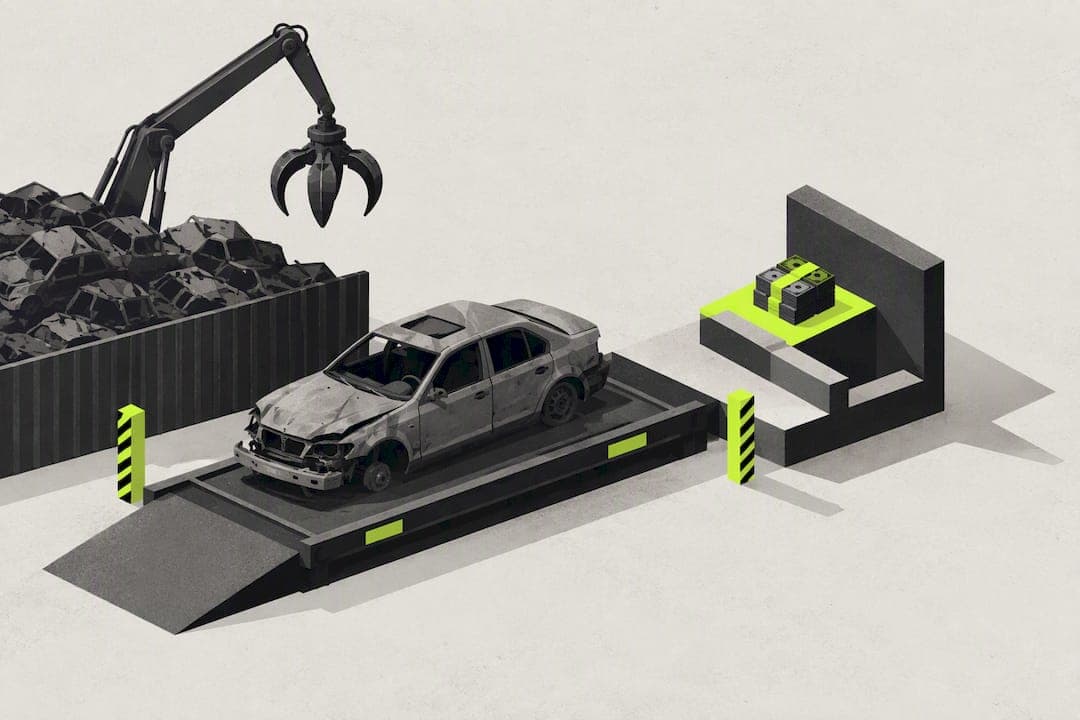
Most complete cars generally scrap for prices within a moderate per-ton range in 2026, which translates to a wide payout range for average sedans and higher values for heavier trucks and SUVs. Your actual payout depends on several factors including the vehicle's weight, its mix of metals like steel, copper, and aluminum, and its overall condition. Before you accept any offer, check a couple of local quotes and have your title and ID ready.
TL;DR:
- Vehicle type offers a rough benchmark: compact cars bring $180 to $400, while pickups may reach $750 or more before unusual parts are valued.
- Yards often price catalytic converters and reusable parts separately; electric and hybrid vehicles may contain up to twice the copper, complicating shell pricing and processing.
- Ask whether each offer uses actual scale weight or an estimate, includes towing, and is priced per ton, per pound, or for the whole vehicle.
- A missing title may not prevent a sale: buyers may accept registration and photo ID, but state rules vary; keep a bill of sale.
Table of Contents
- Current 2026 Price Snapshot: Per-Ton and Per-Pound Ranges
- How Recyclers Calculate What Your Car Is Worth
- Scrap Prices by Vehicle Type: What to Expect
- Practical Tips to Get the Best Payout
- Title, Paperwork, and Payment Basics
- Finding a Buyer and What Happens at Pickup
- How a Local Buyer Simplifies the Sale
- What Sellers Actually Experience in 2026
- Get Paid Today for Your Junk Car
- FAQ
- Sources
Current 2026 Price Snapshot: Per-Ton and Per-Pound Ranges
Scrap yards price complete vehicles mostly based on weight, with national price snapshots in 2026 generally falling within a broad range per ton that varies by week and yard. That range translates to roughly $0.075 to $0.15 per pound once a car is weighed in. A compact car weighing around 2,800 pounds may fetch a moderate payout within a typical range, while heavier trucks can command higher prices before accounting for catalytic converters or reusable parts.
Steel is the backbone of that math. The Mineral Commodity Summaries 2026 report on iron and steel scrap shows the average delivered price for No. 1 heavy melting steel scrap came in around $319 per metric ton in 2025, with domestic scrap consumption and steel production both ticking up slightly. That figure gives you a useful anchor, since most of a car's scrap weight is ferrous steel.
A few reference points worth knowing before you call a yard:
- Steel scrap (No. 1 heavy melting) averaged about $319 per metric ton in 2025.
- Copper and aluminum trade separately and at much higher per-pound rates than steel, so their share of a vehicle's weight matters even when it is small.
- Whole-car price snapshots in 2026 typically fall within a moderate per-ton band, though regional and weekly fluctuations occur.
The national steel scrap average sat near $319 per metric ton in 2025, according to the USGS Mineral Commodity Summaries, and that number ripples directly into what yards can afford to pay for a complete vehicle. Prices move with global steel demand and shipping costs, so a quote you get this month may differ from one next month even on the identical car.
How Recyclers Calculate What Your Car Is Worth
Yards start with weight, not sentiment. A car gets weighed on a certified scale, and the payout is calculated against the current per-ton rate for whatever grade of scrap it falls into. Most passenger vehicles qualify as a mix of sheet steel and heavier structural steel, so the yard applies a blended rate rather than a single number.
Metal mix matters almost as much as total weight. Ferrous steel makes up the bulk of a car's mass, but copper wiring, aluminum wheels, and aluminum engine components all carry higher per-pound value and get sorted out separately when possible. Copper content can also work against the steel price: higher copper contamination in shredded steel scrap lowers the grade and the rate a yard can get for it downstream, which is one reason electric and hybrid vehicles complicate valuation. The OSTI scrap supply chain study notes that electric and hybrid vehicles can carry up to twice the copper of a typical gas car, and separating that copper before shredding adds cost even as it adds value elsewhere in the stream.
Condition changes how a car gets processed. A running or mostly intact vehicle might go to a dismantler first, who pulls working parts for resale before sending the shell to a shredder, while a wrecked or flood-damaged car often goes straight to the crusher. Catalytic converters are the single biggest condition-driven swing: they contain platinum-group metals and are priced separately from the rest of the car, often adding a meaningful bump to the total offer.
Title status and environmental compliance affect what a yard will pay too. Fluids need to be drained before shredding, and most states require some form of ownership proof before a yard can legally process the vehicle.
Pro Tip: Ask any yard whether their quote is based on actual scale weight or an estimate, since estimates tend to run low.
A few mechanics worth remembering:
- Weight is measured on a scale, not guessed from the vehicle's specs.
- Copper contamination can lower the grade of steel scrap even as it raises nonferrous value.
- Catalytic converters and intact parts are usually priced separately from base scrap weight.
Scrap Prices by Vehicle Type: What to Expect
Vehicle class is a fast way to ballpark your payout before you get a formal quote, since weight scales roughly with body size.
- Compact cars (around 2,500 to 2,900 pounds) typically scrap for $180 to $400.
- Midsize sedans (around 3,200 to 3,600 pounds) typically land between $240 and $500.
- SUVs (around 4,000 to 4,800 pounds) often scrap for $300 to $650.
- Pickup trucks (around 4,500 to 5,500 pounds, more for heavy-duty models) can bring $350 to $750 or higher.
- Minivans (around 3,800 to 4,300 pounds) generally fall between $280 and $570.
These ranges assume a straightforward weight-based calculation at a per-ton rate near the midpoint of the current national band. A heavy-duty pickup with a diesel engine and larger wheels can push past the top of its range because of extra steel and aluminum mass. Electric and hybrid vehicles are a special case: their battery packs and wiring harnesses carry more copper, which the OSTI study flags as a factor that can both raise nonferrous value and complicate how a yard prices the shell. Intact classic cars sometimes sell for far more to a parts buyer or collector than they would ever fetch as scrap weight, so it is worth checking that market before assuming scrap is your only option.
Practical Tips to Get the Best Payout
A little prep before you call a yard can meaningfully change your final number.
- Gather your title, registration, and photo ID so a buyer can finalize the sale without a second trip.
- Remove personal items from the car and note the VIN, since most buyers ask for it when quoting.
- Decide whether to leave the battery and tires in place or sell them separately, since some buyers pay more for a complete vehicle and others deduct for missing parts.
- Check recent scrap price trends in your area before accepting the first number you hear.
- Request at least two or three quotes and ask each buyer to explain their price basis, whether that is per ton, per pound, or a flat offer.
Pro Tip: Always ask whether a quote already includes towing, since a lower headline number with free pickup can beat a higher one that charges for the tow.
Timing can matter more than people expect. Steel scrap prices move with broader metal markets, so a quote you get on a Tuesday might not match one from three weeks earlier or later. If your car is sitting and not costing you money to store, it rarely hurts to watch prices for a week or two before committing.
Title, Paperwork, and Payment Basics
Most states require proof of ownership before a buyer can legally purchase and scrap a vehicle, but a clear title is not always mandatory. Many buyers accept current registration plus a matching photo ID when a title is lost or was never transferred, and we buy vehicles without a title under those same conditions.
- Cash paid at pickup is the most common and fastest payment method in this industry, and it avoids the wait that comes with a mailed check.
- Federal reporting rules generally require businesses to file paperwork on cash transactions over $10,000, which rarely applies to a single junk car sale but is worth knowing if you are selling multiple vehicles at once.
- Keep a copy of any bill of sale or release of liability for your own records after the sale closes.
Finding a Buyer and What Happens at Pickup
Compare quotes on the same basis: ask whether a number is per ton, per pound, or a flat price for the whole vehicle, and whether towing is included. A buyer who will not explain how they arrived at a number is a signal to keep calling around.
At pickup, expect a quick visual inspection to confirm the vehicle matches what was described on the phone, especially missing parts or major damage that was not mentioned. A legitimate buyer tows the car on a flatbed or with a wheel-lift tow truck and pays before driving away.
- Watch for vague weight estimates with no scale ticket or stated basis.
- Watch for last-minute deductions that were not mentioned during the quote.
- Watch for buyers unwilling to put an offer in writing before the truck arrives.
- Check local scrap yard listings or call two or three buyers the same day, since prices can shift week to week.
If your car still runs and you are unsure whether repair makes more sense than scrapping, a quick look at basic electrical system and battery upkeep can help you decide whether the fix is worth it before you call a scrap buyer.
How a Local Buyer Simplifies the Sale
We built our process around the two things sellers care about most: speed and certainty. We offer free towing on every purchase and pay cash at the moment of pickup, so there is no mailed check to wait on and no surprise towing bill subtracted from your total. We buy cars, trucks, and SUVs in any condition, including wrecked, flood damaged, high mileage, or not running, which removes the guesswork sellers often face when a vehicle is too far gone for a trade-in but still has scrap value.

What Sellers Actually Experience in 2026
Sellers consistently report that payouts vary more by region and by week than by the car itself, and that a fast, no-hassle sale often beats chasing an extra few dollars from a third quote. The clearest takeaway: if your car is costing you storage space or stress, take a solid quote now rather than holding out for a market move that may not come.
— Yoshua
Get Paid Today for Your Junk Car
Getting an offer takes a few minutes: tell us the year, make, model, and condition of your vehicle, and we give you a straightforward quote with no obligation to accept it.

- Have your title or current registration and a photo ID ready, even if the title is missing.
- We handle free towing and pickup as part of every purchase, no hidden fee attached.
- Payment happens in cash at the moment we pick up the vehicle, not days later.
- We buy trucks and SUVs alongside sedans and compacts, regardless of condition.
Request your instant cash offer and get a real number today instead of waiting on a mailed check or a buyer who charges for the tow.
FAQ
How much will a scrap yard pay for a car?
Most complete cars scrap for somewhere between $150 and $750 depending on weight and current per-ton rates, with heavier trucks and SUVs often bringing more. The exact number depends on your vehicle's weight, its metal mix, and whether it has an intact catalytic converter.
Will scrap prices go up in 2026?
Scrap steel prices move with broader metal markets and have shown modest year-over-year increases, with the 2025 average near $319 per metric ton for No. 1 heavy melting steel. Short-term direction is hard to predict, so checking current local quotes is more reliable than waiting on a forecast.
What is the $3,000 rule for cars?
There is no single nationwide rule specific to junk car sales; such language is sometimes used loosely to describe state titling or sales-tax thresholds that vary by location. Check your state's motor vehicle agency for the exact dollar threshold that applies to your sale.
What are the current scrap prices in Michigan?
Scrap prices vary by state and even by yard within the same city, and we do not have Michigan-specific figures to share. The national steel scrap benchmark near $319 per metric ton in 2025 is a reasonable starting point, but a local quote will always be more accurate than a national average.
How long does it take to get paid for a scrap car?
Many sales close the same day or within a day or two once a quote is accepted, since pickup and cash payment typically happen together. Having your title or registration and ID ready ahead of time is the biggest factor in keeping the timeline short.
Sources
- Mineral Commodity Summaries 2026 — Iron and Steel Scrap
- Scrap supply chains and residual impacts: benchmarking price implications