
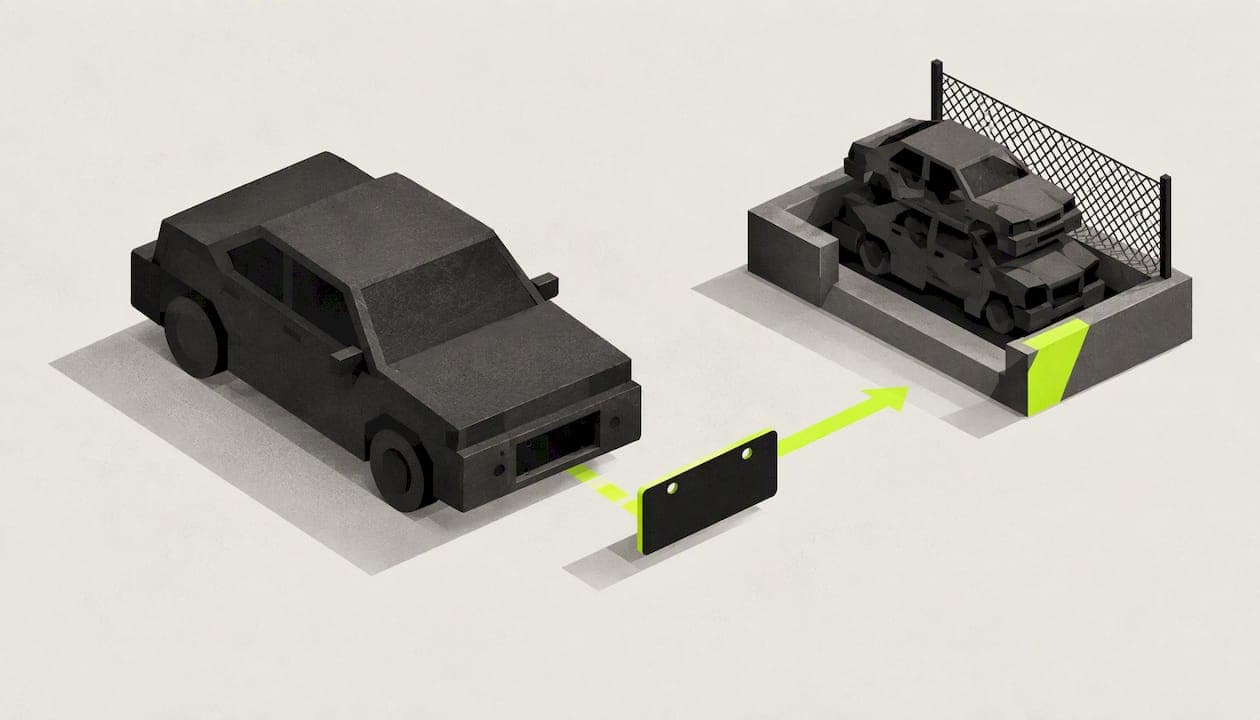
Yes, take the license plates off before the tow truck leaves. In Ohio the law puts that job on you as the seller, and the plates are the last thing tying you to a car you no longer own. This guide covers what Ohio requires, how other states differ, what to do with the plates once they are off, and the other things to check before your junk car is hauled away.
TL;DR
- In Ohio, registration ends when ownership transfers, and the previous owner must remove the plates right away, with a few statutory exceptions.
- Plates left on a junked car can leave you answering for tickets, tolls and fraud you had nothing to do with.
- Other states may want plates turned in, kept, or moved to another vehicle, so check your own state's DMV if you live outside Ohio.
- Before pickup, also get a receipt, handle the title, and confirm the title and registration are cancelled.
- A local yard that pays cash at pickup should have no problem waiting while you unscrew the plates.
Table of Contents
- What Ohio law says about plates on a junk car
- Why leaving the plates on is a bad idea
- How the rules differ outside Ohio
- What to do with the plates once they are off
- Before the tow: a step-by-step checklist
- What happens to the title in Ohio
- No title, no plates, or expired tags?
- Our perspective: take the plates, keep the paper trail
- Ready to sell? Here is how we work
- FAQ
- Sources
What Ohio law says about plates on a junk car
Ohio's rule is in Section 4503.12 of the Ohio Revised Code. When ownership of a vehicle transfers, the registration expires, and the original owner must immediately remove the plates, except in the situations the statute lists. Selling a car for scrap or junk is a transfer of ownership like any other, so the rule applies to you.
The Clark County, Ohio, Scrap Vehicle Processing Guide says the same thing in plain terms for people scrapping a car. Owners who sell or scrap a vehicle must remove the plates at transfer, and the stated reason is to reduce the risk of fraud.
The practical version: do not hand over a car with the plates still bolted on, and do not tell the buyer or the tow driver to take care of it. Take them off yourself, ideally before the truck arrives, so nothing about the pickup is rushed.

Why leaving the plates on is a bad idea
A plate links a car to a name. If the car vanishes into a yard and the plate is still on it, or ends up somewhere you did not expect, that link can come back to you.

The Washington State Department of Licensing explains the risk well on its page about disposing of old plates. Owners are required to remove plates once they no longer own the vehicle, and doing so protects them from being held responsible for charges the car racks up after it changes hands, such as parking, towing, toll or speed camera violations. Washington's rules are not Ohio's, but the logic travels: a plate that still points to you is a plate that can generate paper in your name.
Here are the situations that tend to cause trouble:
- Tickets and tolls. A car that is moved, stored or driven before it is crushed can pick up violations tied to the plate number.
- Fraud. A plate on a car that is later resold, or parts of it reused, can be used to make a vehicle look legitimate.
- Registration confusion. If the state still shows the plate as active on a car you sold, you may get renewal notices or insurance questions for a vehicle that is long gone.
None of this is likely on any given day. The point is that removing the plates takes about five minutes with a screwdriver, and the problems it prevents can take months to untangle.
How the rules differ outside Ohio
Our yard serves the Cincinnati Tri-State area, so some readers will be coming from Kentucky or Indiana, and others from farther away. Plate rules are set state by state, and even the government pages disagree on what you do after the plates come off.
| State | What the official page says |
|---|---|
| Ohio | Remove plates at transfer of ownership, subject to statutory exceptions (Ohio Revised Code 4503.12) |
| Iowa | Owners disposing of a vehicle to a recycler remove the registration and plates and return them to the county treasurer (Iowa DOT) |
| Washington | Remove plates when you no longer own the vehicle to avoid liability for tickets (Washington DOL) |
| Delaware | Surrender plates to the DMV before cancelling liability insurance, including on a junked vehicle (Delaware DMV) |
| New Jersey | For junked vehicles, the MVC wants a junk receipt on company letterhead with the VIN and the date junked (NJ MVC) |
The pattern is that removal is nearly universal, while the next step varies. Some states want plates returned, some let you keep or reuse them, and some tie plate surrender to cancelling insurance. If you live in Kentucky, Indiana or elsewhere, check your state's motor vehicle agency or your county clerk before you cancel anything.
What to do with the plates once they are off
This is where most of the confusion starts, because removing plates is the easy part. Your options depend on the state:
- Return them. Iowa, for example, tells owners who dispose of a vehicle to a recycler to return the registration and plates to the county treasurer. Delaware requires surrender to its DMV before you cancel liability insurance.
- Move them to another vehicle. Some states let plates stay with the owner and go onto a replacement car. In Ohio, the statute that requires removal also carries exceptions, so ask the BMV how it applies if you are buying another vehicle.
- Destroy them. If your state does not want them back and you have no other use, destroying the plates keeps anyone from reusing them. Bend them, cut them, or deface the numbers before you recycle the metal.
Do not toss intact plates in the trash or leave them in the glove box of a car headed to the yard. Whichever route applies, keep a note of what you did and when.
Before the tow: a step-by-step checklist
You do not need a whole afternoon. Run through these in order and the pickup takes a few minutes.
1. Clean the car out
Check the glove box, console, door pockets, trunk, spare tire well and under the seats. Registration, toll transponders, garage door openers, sunglasses and paperwork with your address all tend to hide there. Once the car is on the truck, it is gone.
2. Take the plates off
Use a screwdriver or a small socket set. Remove both plates if your car has two. Remove any registration stickers or window decals too if your state asks for them back. Do this before the driver arrives, so there is no pressure.
3. Get your paperwork in order
In Ohio, the title is the key document, and the BMV and county clerks care about what happens to it. If you have it, keep it handy and do not sign anything you do not understand. Our guide to junk car paperwork in Ohio and Kentucky lists what to have ready. If you have no title, read our walkthrough of the options when the title is missing.
4. Get a receipt
The Clark County guide advises sellers to request a receipt that lists the buyer's name, address and phone number, a description of the vehicle including its VIN, and the purchase price. It also says to have your signature notarized or to complete the transaction at a county title office. That receipt is your proof the car left your hands on a particular day. If you want to write a bill of sale yourself, see what to write on a junk car bill of sale in Ohio.
5. Cancel what needs cancelling
Once the car is gone, deal with insurance and registration. Do it in the right order for your state: Delaware, for instance, wants plates surrendered before you cancel liability insurance. New Jersey asks for a junk receipt with the VIN and the date the car was junked, and says that for a total loss you may need official insurance documentation rather than something like a tow receipt.
6. Confirm the title is inactive
The Clark County guide advises Ohio owners to check online through the Ohio BMV that the vehicle title has been inactivated after scrapping or selling, to reduce the chance of fraud. Put a reminder in your calendar for a couple of weeks after pickup.
What happens to the title in Ohio
The plates are only half of the paperwork. Under Section 4505.11 of the Ohio Revised Code, when a motor vehicle is dismantled or destroyed, the owner must surrender the certificate of title to a clerk of a court of common pleas for cancellation. The Scrap Vehicle Processing Guide adds that scrap metal processors must mark the title as TO BE CANCELED and forward it to the clerk within 10 days of acquiring the vehicle.
You do not have to chase that process yourself when you sell to a buyer that handles it, but you should know it exists. It is the reason the receipt and the later online check matter: they show the car's paper trail ended with you.
No title, no plates, or expired tags?
Not every junk car has a clean file. A few common situations:
- Plates already missing. Say so up front. Then the question is mainly your registration and ID. Our page on junk cars without a title in Cincinnati explains how we handle it.
- Expired tags. An old sticker does not stop you from selling. See selling a car with expired tags for the state checks to make.
- Plates on a car you cannot reach. If the car is in a garage, a yard or a lot, tell us where it is when you ask for a quote so the driver can plan the pickup.
Our perspective: take the plates, keep the paper trail
We buy junk cars in Cincinnati and the Tri-State area, and the plate question comes up on a lot of calls. Our view is simple. The plates belong to you, not to the car, and removing them is your protection. We would rather a seller take five minutes to unscrew them than have a plate follow a car we are about to tow.
We pay cash at pickup and tow for free, so the whole visit is short. That is exactly why the checklist above is worth running before the driver pulls up. You deal directly with the local yard that makes the offer, sends the truck and hands you the cash, so there is nobody in the middle to blame if a step was skipped. We also buy vehicles without a title as long as you can show current registration and ID, so a missing title does not mean you are stuck. Keep your receipt, confirm the title is cancelled, and you are done.
— Yoshua
Ready to sell? Here is how we work
If your car is wrecked, not running, high mileage or flood damaged, we can quote it, tow it for free and pay you in cash when the truck arrives. There are no hidden towing fees and no pressure to accept an offer. Start with our cash for junk cars page, or go straight to a free junk car removal request.

Want to know how the number is worked out first? Read why scrap value depends on weight, or see what happens to junk cars after you sell them.
FAQ
Do I need to return license plates in Ohio?
Ohio law requires you to remove the plates when ownership transfers, apart from statutory exceptions. The statute does not by itself say you must mail them anywhere, so ask the Ohio BMV or your county title office what applies to your situation. Whatever you do, do not leave them on the car.
Should I remove my license plates before scrapping or junking my car?
Yes. Removing them protects you from charges and fraud tied to a car you no longer own. Washington's licensing department says plate removal protects owners from tickets and tolls after the vehicle changes hands.
Can I keep the plates or put them on another car?
It depends on the state. Some states want plates returned to the county, while others allow owners to keep them or move them to another vehicle. In Ohio, ask the BMV how the exceptions in the statute apply before you buy a replacement.
What else should I remove before junking a car?
Empty the glove box, trunk and under-seat areas. Take registration, personal items, toll transponders and anything with your address on it. Then take the plates and any state-required stickers.
How do I get rid of old license plates?
First check whether your state wants them back. If it does not, destroy them so no one can reuse them, then recycle the metal. Keep a note of the date in case the state asks later.
Sources
- Section 4503.12, Ohio Revised Code
- Section 4505.11, Ohio Revised Code
- Scrap Vehicle Processing Guide, Clark County, Ohio
- Dispose of old plates, Washington State Department of Licensing
- Vehicle Disposal, Iowa Department of Transportation
- Vehicle Services FAQs, Delaware Division of Motor Vehicles
- Uninsured Motorist Enforcement FAQs, New Jersey MVC