
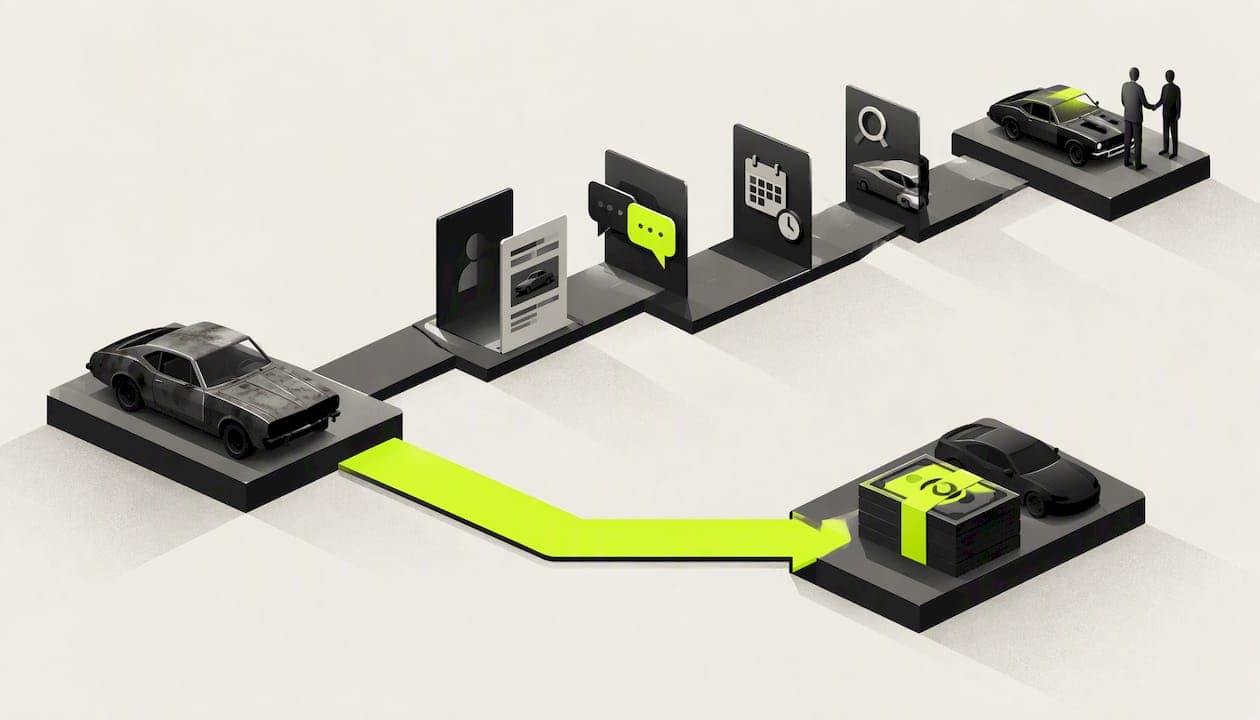
You can sell a project car two ways. List it for hobbyists and flippers, who may pay more but take time. Or sell it to a buyer who takes the car as-is, tows it and pays you the same day. The right choice depends on what the car is worth in parts and projects, how much time you have, and whether the car is still a good start for someone else.
This guide walks through that decision. It covers how to tell a real project from a pile of parts, how to price it, and what paperwork protects you. It also covers when a local cash buyer is the smarter move. The paperwork details are for Ohio, where we work, so check your own state's rules if you live elsewhere.
TL;DR
- A project car with a solid body, a clear title and an honest listing can net 15 to 30% more in a private sale than from a quick-sale service. You pay for that with time and haggling.
- If the repairs would cost more than about 50 to 75% of what the car is worth running, or the car is 12 to 15 years old with 150,000+ miles, selling as-is usually beats fixing it.
- Always use a written as-is bill of sale. In Ohio, the seller's signature on the title must be notarized.
- If the car is rusted out, abandoned in a yard, or missing parts, a cash buyer with free towing saves you months of listing and no-shows.
Table of Contents
- First, decide what you actually have
- Fix it first, or sell it as-is?
- Your four ways to sell, compared
- How to sell a project car privately
- Paperwork that protects you
- When the title is missing
- Our perspective: when a project should go to a cash buyer
- What a cash buyer will and will not pay for
- Before the tow truck arrives
- Sell your project car for cash in Cincinnati
- Common mistakes to avoid
- FAQ
- Sources
First, decide what you actually have
People use "project car" for three very different things, and each one sells differently.
A true project. The car has a desirable shape, a straight frame, a mostly complete body and interior, and a title in your name. Think of a classic that needs paint and an engine rebuild, or a clean older sports car with a failed transmission. Hobbyists want these. They will pay for the potential.
A parts car. The car has real value in its pieces, such as an intact drivetrain, glass, wheels, body panels or electronics. But it is too far gone to restore. A parts hunter or a salvage yard will pay for it, usually by weight and parts demand.
A stalled project. The car is half-disassembled, the parts are in boxes, and your garage has been taken over for three years. Strictly speaking, it is a project. In the market, it is closer to a parts car, because a buyer has to trust that every box is there.

Be honest about which one you own. Most of the pain in selling a project comes from pricing a stalled project as a true one. The buyer sees the missing pieces in about thirty seconds, and you lose the sale and a week of your time.
Quick checks that settle it
- Is the frame straight and solid? Rust through the frame rails or floor pans is the number one reason a project becomes scrap.
- Is it complete? A buyer will pay far more for a car with all its trim, glass and small parts than for one that needs a year of hunting.
- Is the title clean and in your name? A project without a title is a much harder sale. We cover that below.
- Does the model have a following? If clubs, forums and parts suppliers exist for it, hobbyists will look. If not, you are selling to a very small pool.
Fix it first, or sell it as-is?
Most owners ask whether to finish one more repair before listing. The rule of thumb is simple. Compare the repair estimate with the car's market value in good working condition. If the repair costs more than 50 to 75% of that value, or the car is over 12 to 15 years old with 150,000+ miles, selling as-is is almost always the sounder financial call.
A worked example: say your car would sell for $6,000 if it ran well, and the repair quote is $4,200. That is 70% of the value, inside the danger zone. Even if you do the work, you may get back less than you spent, and you will still need to find a buyer. Sell it as it sits.
Now the opposite case. The same car needs a $500 sensor and a battery. That is under 10% of its value, and a running car widens your buyer pool a great deal. Do the cheap fix.
One caution on dealer logic. Dealers can recondition cars cheaply because they have wholesale parts and lower internal labor rates. A $1,000 retail repair may add far less than $1,000 to what a dealer offers, and the reverse holds for you: your retail repair bill never fully comes back in the sale price. So repair only what is cheap and obvious.
Your four ways to sell, compared
| Route | Typical speed | Money | Effort | Best for |
|---|---|---|---|---|
| Private listing to hobbyists | Weeks to months | Highest, if the car is a real project | High: photos, calls, test visits, paperwork | Complete, desirable cars with a clean title |
| Parting out | Months | Can beat everything else, but only for popular models | Very high: removal, storage, shipping, buyers | Cars with valuable, in-demand parts and a spare garage |
| Dealer trade-in or online quote | Days | Moderate, often a market-based offer if you compare several | Low to moderate | Cars that still run and drive |
| Local junk car buyer | Same day to a few days | Based mostly on weight and condition | Very low: one call, free towing | Non-running, rusted, wrecked, incomplete or title-light cars |
The table hides one truth: time has a price. If you have a $2,500 car and a month of weekend calls from strangers, your effective hourly rate may be well below what you would pay yourself to do anything else. For the cheaper end of the market, speed and certainty are real value.
How to sell a project car privately
If your car is a true project, a private sale is usually worth the effort. Here is how to do it well.
Write the listing like a buyer's checklist
Transparency is a sales tactic here. Sellers who list what is broken and give repair estimates build trust and filter out tire-kickers, leaving the hobbyists and parts hunters who will actually pay. Include:
- Year, make, model, trim, engine and transmission, plus the VIN.
- The mileage, and whether the odometer works or is reliable.
- What runs, what does not, and what you know is wrong. Name the failed part.
- A list of what is included, such as spare parts, boxes and manuals.
- Rust: say where it is. Photograph it.
- Title status: clean, lien, or lost.
- Your honest asking price and whether you accept offers.
Take photos that sell the potential
Wash the car, even if it does not run. Shoot all four corners, the interior, the engine bay, the undercarriage, the VIN plate and every rust or damage spot. Buyers trust sellers who show the ugly parts. Take them in daylight, and push the car out of the garage if you must.

Price against comparable sales
Search completed sales of the same model in similar condition, not asking prices. Then price a little above what you will accept. Since a hobbyist will inspect it, a price near the top of the realistic range with a note about what is included works better than a bargain-bin number that attracts flippers.
Screen buyers and stay safe
Meet in daylight in a public place or at your home with someone else present. Do not hand over keys or the title until payment is in your hand, and do not accept a check for a car you cannot get back. Cash at the time of transfer, or a bank-verified payment at the bank, is the safe version.
Paperwork that protects you
This is where project car sales go wrong. Do these things every time.
Use a written as-is bill of sale. A written "AS IS - NO WARRANTIES" bill of sale, with the buyer acknowledging the damage, protects you from later disputes. Private sellers are generally not covered by the Used Car Rule and cannot offer meaningful warranties anyway, so put it in writing. Include both parties' names and addresses, the VIN, the price, the date and the mileage.
Sign the title properly. In Ohio, the seller completes the assignment of ownership on the back of the title and has their signature notarized, then gives it to the buyer. Do not leave it blank, and do not sign in front of nobody. Every owner on the title must sign. If a lender holds a lien, you must pay it off and get the lien released before you can transfer.
Disclose the odometer. Federal law requires odometer disclosure on every transfer of ownership for the first 20 years for model year 2011 and newer vehicles. Older cars are exempt from the federal requirement, but write the reading on your bill of sale anyway, and note "not actual mileage" if you do not trust the gauge.
Take your plates and cancel your coverage. Remove the license plates before the car leaves. Keep a copy of the bill of sale and take a photo of the signed title. Only then call your insurer. Check the Ohio BMV site or your local county clerk of courts title office for the current steps for your situation.
When the title is missing
Project cars bought years ago at a barn sale or from a relative often have no title in the owner's name. That changes the sale. Most private buyers will walk away without a title, and the car becomes hard to register.
You have options. You can apply for a duplicate if the title was yours and was lost, or work through the state's process if the car was inherited or bought without paperwork. Our guide to junking a car without registration lays out four paths when the title is missing. And if you want to skip the paperwork chase, we buy vehicles without a title as long as you can provide current registration and ID. See our page on junk cars for cash without a title in Cincinnati.
Our perspective: when a project should go to a cash buyer
We buy cars for a living in the Cincinnati Tri-State area, and we see the same pattern every week. An owner has a car that was going to be finished "next summer" for years. It now sits behind a garage or on a lawn, it does not run, and the neighbors, the HOA or the owner's spouse is done waiting.
Here is our honest view. If your car is a complete, rust-free, desirable model with a clean title, list it privately and be patient. We will not tell you to take less. A hobbyist will pay more than we can, and you should get that money.
But many projects are not that car. If the car has been outside for years, if it is missing major parts, if the floors are gone, or if you simply need it out, a direct sale is a better deal than it sounds. Our value comes mainly from the vehicle's weight and condition, so a heavy, complete car is worth more than a shell. We give you a free quote with no obligation, and you can say no.
What we do differently from the national broker networks is simple. You deal directly with the local yard that makes the offer, sends the truck and pays the cash. We tow for free with every purchase, we pay cash at pickup, and we do not take hidden fees or last-minute deductions from the offer. The person who quoted the price is the one whose truck shows up.
One piece of advice we give everybody: before you call anyone, get your title or registration, photo ID and VIN in one place. It makes the whole thing take minutes instead of days. And if you do not know what the car is worth, our guide to calculating junk car value yourself in about 10 minutes will give you a floor to compare any offer against.
— Yoshua
What a cash buyer will and will not pay for
A junk car buyer is not a hobbyist. We value your car on the basis of what it is worth as a vehicle to resell, to part out or to recycle. That means:
- Weight matters. A full-size truck or SUV carries more scrap metal than a compact car. Our scrap car prices guide explains how this shapes offers in the Cincinnati area.
- Completeness matters. A car with its engine, transmission and catalytic converter in place is worth more than one that has been stripped.
- Condition matters, but not the way it does in a private sale. A non-running engine, a blown head gasket, flood damage or a wreck will not stop us from buying. See our page on selling a car with a blown head gasket for an example.
- Rare or desirable models can still fetch more elsewhere. If you own something unusual, get a second opinion from a club or a specialist before you accept any single offer.
The trade-off is plain. A private buyer may pay for a car's future. A cash buyer pays for what it is today, and pays right away. As a rule, comparing more than one offer is wise, as industry reporting suggests when it advises comparing online offers with a local dealer's trade-in quote. Our trade-in versus private sale guide shows how that comparison works for cars that no longer run well.
Before the tow truck arrives
Whichever route you take, a few steps save trouble.
- Gather the paperwork. Title or registration, photo ID, and any lien release.
- Remove personal items. Check the glovebox, trunk and under the seats. Take the toll tag, garage opener and any loose tools.
- Remove parts you want to keep. If you are keeping the wheels, the stereo or a rare part, pull them before you get a quote, and tell the buyer. A quote is based on what is there.
- Think about hazardous materials. The EPA says that lead-acid batteries, mercury switches and fluids such as oil, antifreeze and brake fluid must be removed and managed under environmental rules, and never go to a standard municipal landfill. A licensed buyer or recycler handles this for you. If you are tempted to dispose of the car on your own, do not drain fluids onto the ground.
- Clear access. Make sure a truck can reach the car. Tell the buyer if it is blocked in, on a slope or off a paved surface.
- Get the price in writing, or confirm it by phone, before pickup. Ask whether towing is free and whether there are any deductions at the curb.
Sell your project car for cash in Cincinnati
If your project is a non-running car, truck or SUV, or you are tired of waiting on a buyer, we can help. We buy vehicles in any condition, including wrecked, salvaged, high-mileage, flood-damaged and not running. We give you a free quote, send the truck at no charge and pay cash at pickup.
Start with a no-obligation number on our instant cash offer page, or read how our cash for junk cars service works. If you have a pickup or an SUV, see our page for selling a truck or SUV for cash. And if the car is sitting somewhere you want it gone from, our free junk car removal page covers pickup.
Common mistakes to avoid
- Pricing on sentiment. The hours and dollars you put in do not add to the sale price. A buyer pays for the car in front of them.
- Hiding problems. It costs you the sale at the inspection, or worse, a dispute later.
- Signing a blank title. Never hand over a title that has not been completed in front of the buyer, and in Ohio never skip the notary.
- Letting the car sit. Cars outside lose value to rust, flat tires, animals and moisture. A project you intend to sell is worth more this month than next spring.
- Taking the first offer without a comparison. Get at least two quotes if the car has any real value.
FAQ
What is the best way to sell a car that needs repairs?
It depends on how much it needs. If the repairs are cheap and obvious, do them and list the car as running. If repairs run past roughly half of the car's working value, sell it as-is, privately if it is desirable, or to a cash buyer if it is not. A written as-is bill of sale protects you either way.
Where can I sell a project car quickly?
A local junk car buyer is usually the fastest route, because the quote, the tow and the payment can all happen in a day or two. A private listing to enthusiasts is slower but can pay more for a complete, clean-title car. Dealer trade-ins work best for cars that still run.
Can I sell a project car without a title?
It is much harder privately, since most buyers and the state want proof of ownership. Some buyers, including us, will take a vehicle without a title if you have current registration and valid ID. Apply for a duplicate first if the title was in your name and you can get one.
Do I need a notary to sell a car in Ohio?
For a paper title, yes. The Ohio BMV says the seller's signature on the assignment of ownership must be notarized. Rules vary by state and by type of title, so confirm with the BMV or your county clerk of courts title office before you sign.
Is it worth parting out a project car instead?
Sometimes, if the model is popular and you have time, space and tools. It takes months, storage and shipping, and you are left with a shell to dispose of. If you only want the car gone, a single sale is simpler.
Sources
- What to Do with a Car That Is Not Worth Fixing (Motoring Chronicle)
- 10 Tips on How to Sell a Damaged Car Privately (Sell Car Advisor)
- Can I Trade In My Car If It Needs Repairs? (EngineerSkill.blog)
- Consumer Alert: Changes to Odometer Disclosure Requirements (NHTSA)
- Managing Hazardous and Solid Waste from End-of-Life Vehicles (EPA)
- Vehicle Titles (Ohio BMV)
- Selling Your Car: What's the Best Option, Dealer or Online? (Car and Driver)