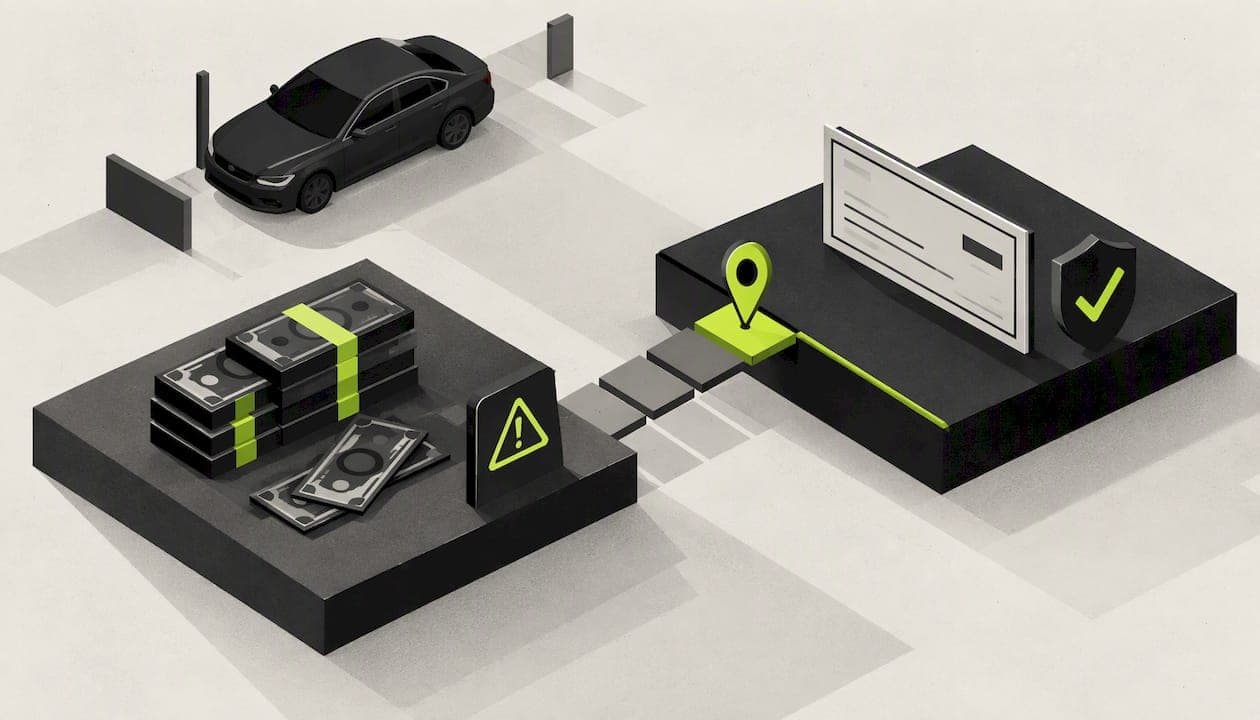
For a car sale, cash is the safer payment, as long as you count it, take it in a safe place and hand over the car only once you hold it. A cashier's check looks safe because a bank issued it. But the FTC warns that you shouldn't rely on the money until your bank confirms the check has cleared, and that can take weeks if the check is forged. If you must accept a check, verify it at the issuing bank, in person, before the car leaves your driveway.
This guide covers how each method works, where each one fails, what to do if a buyer insists on a check, and what changes when the car is a junk car that doesn't run.
TL;DR
- A cashier's check is not the same as cash. Your bank may make the money available within days, but a counterfeit can be discovered weeks later, and you would owe the money back.
- Cash in hand is final. It can't bounce or be reversed, but large amounts need a safe handoff and a close look at the bills.
- If you take a cashier's check, meet the buyer at the issuing bank and have a teller validate it while you watch. Never trust the phone number printed on the check.
- Walk away from any buyer who overpays and asks you to send back the difference.
- For a junk car, a local buyer who pays cash at pickup skips the check question entirely.
Table of Contents
- Why people say a cashier's check is as good as cash
- How the "funds available" trap works
- Cashier's check vs. cash: a side-by-side comparison
- When cash is the better choice
- When a cashier's check can still work
- Our perspective: why we pay cash at pickup
- Selling a junk car: the payment and the paperwork
- How to protect yourself with any buyer
- Get cash for your junk car, no check involved
- FAQ
- Sources
Why people say a cashier's check is as good as cash
A cashier's check is drawn on the bank's own funds, not on the buyer's personal account. That is the reason sellers trust it. A personal check can bounce because the buyer's account is empty. A genuine cashier's check shouldn't, because the bank itself stands behind it.
The word "genuine" is where the trouble starts. Fake checks can look like business or personal checks, cashier's checks, money orders, or checks delivered electronically, according to the FTC. Counterfeits can look identical to real ones, even to bank employees. The FTC calls the belief that a cashier's check is as good as cash one of the most dangerous misconceptions about them, because criminals use advanced technology to forge them.
So the question is not "which payment is backed by a bank?" It is "which payment can no longer be taken back from me?" Only one of the two passes that test.
How the "funds available" trap works
When you deposit a check, the bank credits your account quickly. Federal rules push banks to do this. Under the Regulation CC rules the OCC describes in its bulletin on funds availability, cashier's checks generally have to be made available within one to five business days, depending on factors such as whether the check is local.
That availability is a banking deadline, not a verdict on the check. The money appears in your balance, you spend or transfer some of it, and then the bank finishes its checks. If the check turns out to be counterfeit, the bank reverses the credit. The FTC explains that the depositor is then on the hook for the full amount.
Here is how that plays out in a car sale:
- A buyer offers the full asking price by cashier's check, without haggling.
- You deposit the check. Your app shows the money as available.
- You sign over the title and the buyer drives off.
- Days or weeks later, the bank tells you the check was fake and takes the money back.
You now have no car, no money, and possibly a title already in a stranger's name. AutoHunter's review of payment scams in car sales puts the average loss in scams that use fake payment methods at $4,200, with less than 5% recovered.
Cashier's check vs. cash: a side-by-side comparison
| Factor | Cash | Cashier's check |
|---|---|---|
| Can it be reversed after you accept it? | No | Yes, if the bank later finds it counterfeit or altered |
| When is it truly yours? | The moment you count it | After your bank confirms it has cleared, not when funds first appear |
| Can you verify it on the spot? | Check the bills yourself, or count it inside a bank | Only by meeting the buyer at the issuing bank |
| Main risk | Theft, counterfeit bills, safety during the handoff | Counterfeit checks, overpayment scams, reversed deposits |
| Practical for large amounts? | Awkward, and a risk to carry | Convenient, but only after verification |
| Delay before you can use the money | None | Hours to days at the bank, weeks before it is safe to rely on |
The DealNow guide to private car payments sums up the trade-off well: cash pays you on the spot, with no bounced checks and no waiting, but for high-dollar sales it can be risky and awkward. KeySavvy makes a similar point: cash, wires and cashier's checks are all workable, and each carries limits and real risks.
When cash is the better choice
Cash wins when the amount is modest and you can make the handoff safe. That describes most junk car sales, where the payment is a few hundred dollars rather than tens of thousands.
Cash has three real advantages.
- Finality. Once you have counted it and taken it, no bank process can pull it back.
- Speed. You don't wait for a deposit to clear or for a transfer to land.
- No middleman. No bank, app or third party has to approve the payment, so no one can freeze it.
Cash also has real weak points.
- Counterfeit bills. Check every bill in good light. If the amount is large, do the exchange inside your bank so a teller can check it.
- Personal safety. Meet in daylight, in a public place, or at home with someone else present.
- Records. Write a simple bill of sale with the date, price, vehicle identification number (VIN), and both parties' names. Keep a copy.
For larger sales, the practical fix is to complete the sale at your bank. The buyer hands over cash or a verified payment, a teller handles it, and the money goes straight into your account.
When a cashier's check can still work
A cashier's check is not always a scam. Plenty of legitimate buyers use them for bigger purchases, and sellers often prefer them to carrying thousands in bills. The condition is verification that doesn't rely on anything the buyer gives you.
How to verify one properly
The only reliable method is to meet the buyer at the bank that issued the check and have a teller validate it in front of you. Either of these approaches also works: the teller cashes it for you there, or the teller confirms it and you deposit it on the spot. The FDIC's consumer guidance on fake checks warns against relying on the phone number printed on the check, since that number often connects to the scammer. Look up the bank's number yourself on its official website.
Before you meet, check these things:
- The bank name matches a real bank with a branch you can visit.
- The buyer agrees to meet at that branch during business hours.
- The amount matches the agreed price exactly.
- The payee name matches yours.
If any of those make the buyer hesitate, treat that as your answer.
The overpayment scam
The classic fake check scheme has a recognizable shape. The check arrives for more than the price, and the buyer asks you to send back the difference by wire, gift cards or an app. The FDIC explains that scammers ask you to send part of the proceeds on before the bank tries to clear the check and discovers it is fake.

There is no honest reason to refund an overpayment before a check has cleared. Return the check, or cancel the sale.
One more warning sign comes from AutoHunter's scam guide: a buyer who refuses a secure method, such as cash at a bank or a verified wire, is a primary red flag. Real buyers don't pressure you to pay a fee to receive your own money.
For more on spotting buyer tricks and handling payment safely, this Safe Car Sale Transaction Guide for private sellers is a useful second read. It was written for a Canadian market, so apply its principles rather than its local rules.
Our perspective: why we pay cash at pickup
We buy junk cars in Cincinnati and the Tri-State area, and we pay cash on the spot at pickup. We built it that way because of the question this article asks.
A person selling a car that doesn't run isn't looking for a payment puzzle. They want the car gone and the money in their hand. Making someone wait for a check to clear, or to wonder whether a check will hold up, defeats the point of selling quickly. So we don't delay payment, and we don't make last-minute deductions from the quote we gave you.

There's a second reason. When you sell to a local yard, you deal with the same business that gave the offer, sent the truck and pays the cash. You aren't passed along a broker chain where the person who promised a price isn't the person who shows up. If something looks off, you know who to talk to.
Cash isn't perfect for every sale. If you are selling a running car for several thousand dollars to a private buyer, the bank-branch method we described above is a sound way to do it. For a junk car, where the value is mostly the car's weight and condition, cash at pickup is simple, and it's the safest path we know.
— Yoshua
Selling a junk car: the payment and the paperwork
Payment is half of a safe sale. The other half is making sure the car is legally off your hands. In Ohio, all title work goes through the County Clerk of Courts title office rather than a DMV. According to the Ohio clerk's title guide, the seller completes the assignment on the back of the title in front of a notary. The same guide lists a $15.00 title transfer fee and a 30-day deadline from the sale date, so check the guide for current figures before you act.
A short checklist for a junk car sale:
- Photograph the front and back of the signed title before you hand it over. The clerk's guide stresses keeping a copy.
- Remove your license plates. The guide also advises this when selling a junk vehicle.
- Get a written receipt with the date, price, VIN and the buyer's name.
- Don't sign over a title to a buyer who hasn't paid. Payment and handoff happen together, or not at all.
If you run into a title defect or suspect title fraud, the Clerk of Courts is the first call, and the guide says the Ohio Attorney General's office can help in those cases. If you don't have the title at all, we handle that case too. Our no-title junk car page explains that we buy vehicles without a title as long as you can provide current registration and ID.
How to protect yourself with any buyer
Whether the payment is cash or a check, a few habits do most of the work.
- Settle the payment method before you meet. Ask directly: "Cash, or a cashier's check I can verify at your bank?" A vague answer is information.
- Never hand over the title first. Payment is confirmed, then the keys and title move.
- Ignore urgency. A buyer who says they must pay today by a method you can't verify is working to rush you.
- Don't pay to get paid. Fees for "account upgrades" or "shipping insurance" are scam signs. Real sale payments never require money from you.
- Use an independent phone number. Find the bank or buyer's contact details yourself, never from the paperwork they gave you.
- Report fraud. If a fake check hits you, tell your bank right away and report it to the FTC at ReportFraud.ftc.gov. The FTC's fake check page walks you through it.
The KeySavvy private-sale guide notes that meeting at a bank is inconvenient but is the one way to be sure the transaction is safe. We agree. We would add that for a non-running car, you can avoid the inconvenience altogether by choosing a buyer who pays cash at the curb.
Get cash for your junk car, no check involved
If the car in your driveway is wrecked, flood damaged, high mileage, or simply won't start, you don't have to run a private sale and sort out payment risk yourself. We offer a free quote with no obligation, free towing with no hidden fees, and cash at pickup. Start with our cash for junk cars page, or request an instant cash offer for your car, truck or SUV. You can also read how free junk car removal works from the call to the tow.
There is no pressure to accept the offer. If the number doesn't work for you, you say no.
FAQ
Is a cashier's check as good as cash?
No, not until it has cleared. A genuine cashier's check is backed by the bank's own funds, but counterfeits can fool even bank staff. Your bank may release the money within days, yet it can reverse the deposit if the check is later found to be fake, and you would owe the money back.
How can I verify a cashier's check is real?
Meet the buyer at the issuing bank and have a teller confirm it in person, or cash it there. Don't call the number printed on the check, because that number may reach the scammer. Find the bank's phone number on its official website instead.
Is cash safer than a cashier's check when selling a car?
For the payment itself, yes. Cash can't be reversed or bounced once you've counted it. The risks shift to counterfeit bills and personal safety, which you can reduce by meeting in daylight, checking the bills, or completing the exchange at your bank.
What if the buyer sends a check for more than the price?
Don't send any money back. An overpayment followed by a request for a refund is the standard fake check scheme, and the check will fail after you have already sent your own money. Return the check and end the sale.
Do you pay cash or a check for junk cars?
We pay cash at pickup, so there is no check to clear and no waiting. You get a free quote first, and towing is free.
Sources
- FTC: How to Spot, Avoid, and Report Fake Check Scams
- FTC: Anatomy of a fake check scam
- FTC: A scam story: Secret shopping and fake checks
- FDIC: Beware of Fake Checks
- FDIC consumer news, August 2019 (PDF)
- OCC Bulletin 2007-2: funds availability
- Ohio Clerk of Courts: auto title guide
- AutoHunter: Zelle and Venmo car scams
- KeySavvy: best ways to accept payment for a used car
- DealNow: ways to exchange money in private car transactions